

Carried by 30 nurseries
View Availability at NurseryData provided by the participants of the Consortium of California Herbaria
View additional distribution information on the Jepson eflora
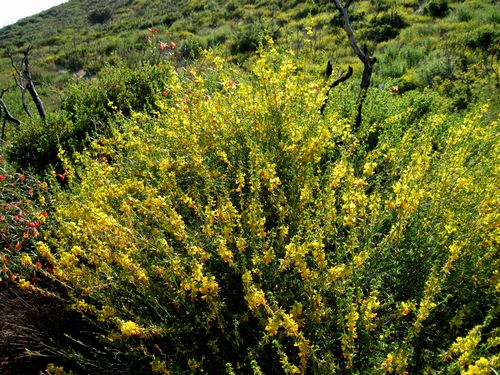
Deer Plant (Acmispon glaber) is a perennial subshrub in the Fabaceae (Legume family). The plant is a pioneer species found in dry areas of California, Arizona, and Mexico. It is grows in many habitats, including chaparral, coastal sand, roadsides and other disturbed areas at elevations below 4900 feet.
The stems are green, erect, somewhat branched, with small, deciduous leaves. When this plant blooms, from about March to August, it displays small yellow flowers bunched together in a flower cluster. The flowers become reddish with age. The fruit consists of a curved pod with two seeds.
There are two recognized varieties with overlapping ranges. Fortunately it is widely available, and would be a great addition to any garden. It has excellent habitat value, and because it is nitrogen-fixing it is often used in restoration projects. Sometimes the wrong variety is planted in an area. Intermediates between the varieties have been observed as a result of such plantings.
Perennial herb
2 - 3 ft Tall
3 ft Wide
Fountain
Fast
Summer Semi-deciduous, Winter Deciduous
None

Yellow
Winter, Spring, Summer
Full Sun
Very Low
Max 1x / month once established
Tolerates cold to 15° F
Medium
Tolerates a wide variety of soils.
Soil PH: 5.2 - 8.2
Can be cut back in late summer or early fall to stimulate new growth
Most often seen in burned or disturbed areas along the coast and inland foothills, valleys and mountains
Chaparral, Coastal Sage Scrub, Coastal Strand, Joshua Tree Woodland
Deerweed has no particular companion plants in the wild, but it can be used with virtually any other natives.
Butterflies and moths supported
16 confirmed and 15 likely
Painted Tiger Moth
Arachnis picta
Bramble Hairstreak
Callophrys dumetorum