

Carried by 6 nurseries
View Availability at NurseryData provided by the participants of the Consortium of California Herbaria
View additional distribution information on the Jepson eflora
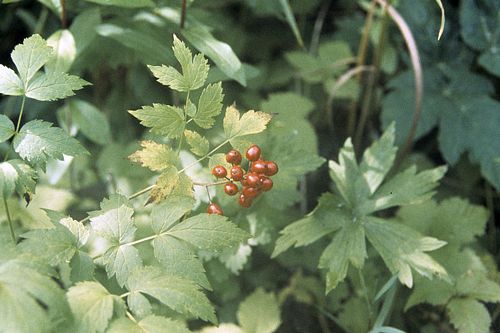
Actaea rubra (red baneberry, chinaberry, doll's eye) is a poisonous herbaceous flowering plant in the family Ranunculaceae, native to North America. They are found growing in shady areas with moist to wet soils, open forest or dry slopes. In Alaska it ranges from the Kenai Peninsula, through Kodiak Island, Bristol Bay, and up the Yukon River. Ecology. Plants are slow growing and take a few years to grow large enough to flower. The western subspecies is ssp. arguta, and the northern subspecies is ssp. rubra. These subspecies are not well differentiated, and in many locations, each grades in to the other over much of their ranges. The foliage is rarely consumed by grazing animals. The poisonous berries are harmless to birds, the plants' primary seed disperser. Uses. This plant is grown in shade gardens for its attractive berries and upright clump forming habit. Native Americans used the juice from the fruits of various baneberry species to poison arrows, and used the root as a herbal remedy for menstrual problems. The root of this species has been used as a strong alternative to Black Cohosh, (Cimicifuga racemosa) for menstrual cramping and menopausal discomfort. Toxicity. These open woodland plants grow 40 cm (16 in) to 80 cm (31 in) tall. The leaves are coarsely toothed with deeply lobed margins. Plants commonly have hairy veins on the undersides of the foliage. Each stem will have either three leaves that branch near the top, or will have three compound leaves and one upright flowering stalk from one point on the main central stem. Plants produce one to a few ternately branched stems which bear clusters of flowers having 3 to 5 sepals that are petal-like and obovate in shape and remain after flowering. The petals are deciduous, falling away after flowering is done. They are clawed at the base and 2. 5 mm to 4 mm long and spatulate to odovate in shape. Flowers have numerous stamens and they are white in color. After flowering green berries are produced. The fruits are ellipsoid shaped berries containing several seeds.
Perennial herb
1 - 3 ft Tall
Winter Deciduous

White
Spring, Summer
Bank stabilization, Deer resistant
Deep Shade, Partial Shade
Moderate
Fast, Medium, Slow
Tolerant of a variety of garden soils as long as sufficient moisture is available.
For propagating by seed: 2-3 mos. cold, 1 mo. warm, and 2-3 mos. cold stratification. May take several mos. for germination. 3 mos. cold, 2-3 mos. warm, and 3 mos. cold stratification may hasten germination.
1, 2, 3, 4*, 5*, 6*, 7*, 14, 15, 16*, 17*, 18
Moist places, deep soils,
Lodgepole Forest, Mixed Evergreen Forest, Red Fir Forest, Forest, Subalpine Forest, Yellow Pine Forest