

Carried by 22 nurseries
View Availability at NurseryData provided by the participants of the Consortium of California Herbaria
View additional distribution information on the Jepson eflora
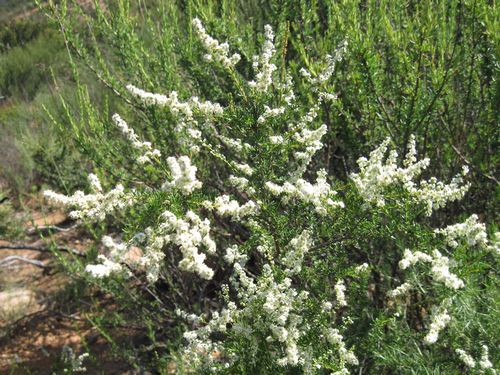
Chamise, or Greasewood, (Adenostoma fasciculatum), a member of the Rose family, is a flowering plant native to California and northern Baja California. This shrub is one of the most widespread plants of the chaparral biome, sometimes forming monotypic stands.
Chamise is an evergreen shrub with dry-looking stick-like branches. The leaves are quite small, sprouting in clusters from the branches. Its leaves are shiny with flammable oils, especially in warmer weather. Chamise is said to be highly flammable but can be more fire-resistant with occasional watering. The branches terminate in bunches of white tubular flowers.
Chamise is one of the best plants for anchoring a slope and resisting erosion, due to its wide-spreading and deeply-penetrating roots. In maturity, it develops a large burl from which it will resprout after fire or severe pruning. In the wild, it is the host plant of a common root parasite, Chaparral Broomrape.
There are three recognized varieties of this plant. Adenostoma fasciculatum var. fasciculatum is found throughout the range of the species. Adenostoma fasciculatum var. obtusifolium is found only in San Diego and Orange Counties. Adenostoma fasciculatum var. prostratum, a low-growing form, is found primarily on the northern Channel Islands. A cultivar known as 'Black Diamond' (Adenostoma fasciculatum 'Black Diamond') is popular and widely available.
Shrub
3 - 13 ft Tall
1 - 8 ft Wide
Upright, Rounded
Slow
Evergreen
Slight

White
Summer, Spring
Groundcover, Hedge
Full Sun
Very Low
Max 2x / month once established
Tolerates cold to 15° F
Fast, Medium, Slow
Tolerant of sand and clay.
Soil PH: 5.0 - 8.0
For propagating by seed: Seeds collected from plants --- no treatment. Seeds collected from duff --- hot water. Alternative treatments: 1. Burn a 1-inch-thick layer of pine needles or excelsior placed over the seed bed.2. Put in oven at 212°F for 5 minutes (Stone and Juhren 1953).3. Soak in 10% H2S04 for 15 minutes.
7*, 8, 9, 14*, 15*, 16*, 17, 18*, 19*, 20*, 21*, 22*, 23*, 24*
Dry slopes and flats, usually higher than coastal sage scrub and below woodlands, from the coast to desert transition
Chaparral
Any chaparral plants make good companions, including Deerweed, Thick-leaved Yerba Santa (Eriodictyon crassifolium var. crassifolium), Toyon (Heteromeles arbutifolia), Lemonade Berry (Rhus integrifolia), Mission Manzanita (Xylococcus bicolor), Del Mar Manzanita (Arctostaphylos glandulosa ssp. crassifolia), other manzanita species, scrub oaks, Yucca species, various cactus species, native bunch grasses, and geophytes such as Mariposa Lilies.
Butterflies and moths supported
9 confirmed and 9 likely
Bank's Emerald Moth
Chlorosea banksaria
Wright's Hulstina
Hulstina wrightiaria
To learn more about this species and its close relative, Red Shanks (Adenostoma sparsifolium), visit the Jepson Herbarium's YouTube channel and watch a short video: https://www.youtube.com/watch?v=j3G8MlSzo1A