

Carried by 6 nurseries
View Availability at NurseryData provided by the participants of the Consortium of California Herbaria
View additional distribution information on the Jepson eflora
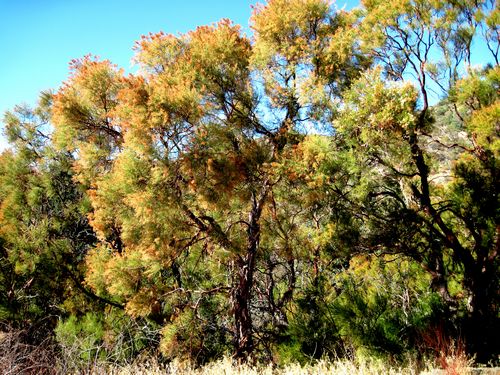
Adenostoma sparsifolium (Redshanks or less commonly, Ribbonwood) is a multi-trunked tree or shrub in the Rosaceae (Rose) family that is native to dry inland slopes or chaparral of Southern California and northern Baja California below 6,000 ft. Shaggy falling shanks or ribbons of bark are one of the strongest characteristics of the tree, hence the common names. Redshanks are closely related to the more abundant Chamise (Adenostoma fasciculatum). Members of this genus are very deep rooted and important slope stabilizers. The foliage is feather-like, allowing the trunk and main branches to show through. The flowers are small but attractive. The fruit is an achene which is valued by small birds. Red Shank is an attractive garden tree, especially when planted in a small grouping.
Tree, Shrub
7 - 20 ft Tall
10 ft Wide
Upright
Moderate
Evergreen
Pleasant

Red, White
Summer, Fall
Hedge
Full Sun
Very Low
Max 1x / month once established
Moderate
Tolerates cold to 10° F
Fast, Medium, Slow
Tolerates a variety of soils including decomposed granite, sand and clay.
Soil PH: 6.2 - 7.2
For propagating by seed: No treatment. Soaking in 10% H2S04 for 15 mins. may improve germination.
7, 8, 9, 14*, 15*, 16*, 17, 18*, 19*, 20*, 21*, 22, 23, 24
Dry slopes, foothills and valleys, generally inland, from San Luis Obispo County southward
Chaparral
Use with other shrubs of inland chaparral such as California copperleaf (Acalypha californica), Yarrow (Achillea millefolium), Manzanita (Arctostaphylos spp.), Milkweed (Asclepias spp.), Ceanothus spp., Mountain Mahogany (Cercocarpus betuloides or minutiflorus), Bush Poppy (Dendromecon rigida), Coffeeberry (Frangula spp.), Flannelbush (Fremontodendron californicum or mexicanum), Chaparral Yucca (Hesperoyucca whipplei), Penstemon spp., Bladderpod (Peritoma arborea), Redberry (Rhamnus crocea), Sumac (Rhus spp.), Matilija Poppy (Romneya coulteri), Sage (Salvia spp.), and Mojave Yucca (Yucca shidigera)
Butterflies and moths supported
0 confirmed and 17 likely
Orange Tortrix Moth
Argyrotaenia franciscana
Rusty Shoulder Knot Moth
Aseptis binotata
To learn more about this species and its close relative, Chamise (Adenostoma fasciculatum), visit the Jepson Herbarium's YouTube channel and watch a short video: https://www.youtube.com/watch?v=j3G8MlSzo1A&t=9s