

Carried by 58 nurseries
View Availability at NurseryData provided by the participants of the Consortium of California Herbaria
View additional distribution information on the Jepson eflora
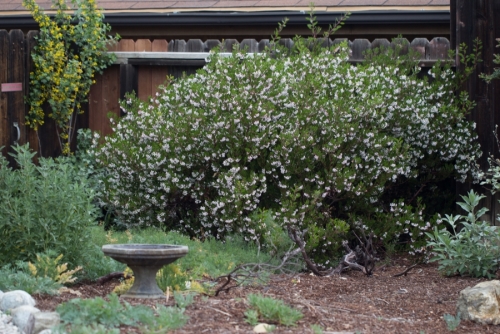
Howard McMinn Manzanita (Arctostaphylos 'Howard McMinn') is an evergreen shrub in the Heath family (Ericaceae). One of the last manzanitas to bloom, this medium-sized, fine-textured shrub has small leaves and tiny pink flowers that appear in late winter through spring. As it matures it will open up and reveal more of it's twisting, red colored branches.
It is a popular choice for gardens due to its tolerance for different soils, summer watering, pruning, and shearing. Combine with other species of manzanitas for a long bloom season. Howard McMinn is tolerant of different types of soils, however, waterlogged soils should be avoided. Stop irrigating after it is established; generally after one or two years. Extra irrigation in summer will result in a short-lived shrub. Prune in fall to remove dead or dying wood, or to improve the shape. Howard McMinn takes shearing well and can be used for a hedge. Plant in full sun in coastal sites, and sun or part shade if planted inland. Although manzanitas are naturally found in chaparral or open woodlands, this cultivar is one of the most tolerant of garden conditions.
Moths, hummingbirds, butterflies are attracted to the flowers, and animals eat the berries. Deer may eat the berries but generally leave the plant alone. The fruits are also edible for people. Traditionally they were dried and ground for a type of granulated sugar. They were also used to make cider. Manzanita is spanish for little apple, and the fruits do indeed resemble little apples.
Shrub
5 - 7 ft Tall
8 - 10 ft Wide
Rounded
slow
Evergreen

White, Pink
Winter, Spring
Hedge
Full Sun
Very Low, Low
Easy
25
Fast, Medium, Slow
Tolerates a wide variety of soils.
Soil PH: 5.0 - 8.0
Prune in late summer to achieve desired height or spread
Works well with a number of low to medium height plants including Ceanothus species, Buckwheat (Eriogonum spp.), and Sages (Salvia spp.).
Thanks to the Theodore Payne Foundation for sharing information about this plant.