

Carried by 15 nurseries
View Availability at NurseryData provided by the participants of the Consortium of California Herbaria
View additional distribution information on the Jepson eflora
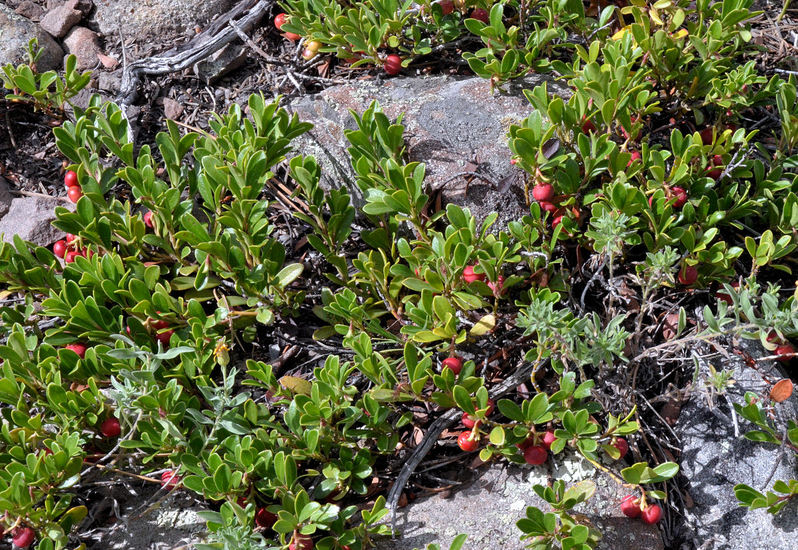
Kinnikinnick is a popular low-growing manzanita that is often used as a groundcover and lawn replacement plant. It is a spreading evergreen shrub that features small, pinkish-white flowers and red berries. Both the flowers and fruit are attractive to birds and insects.
Kinnikinnick and its cultivars grow best in cooler mountainous or coastal regions of California. When planted in hot, dry inland areas, it requires afternoon shade and supplemental water. Kinnikinnick likes loamy, acidic soil.
Shrub
2 ft Tall
10 ft Wide
Spreading
Fast, Moderate
Evergreen
Slight

Purple, Pink, White
Spring, Winter
Deer resistant, Groundcover
Partial Shade, Full Sun
Very Low
Max 2x / month once established
Easy
Tolerates cold to 30° F
Fast, Medium
Tolerates a variety of soils but prefers sandy loam.
Tolerates serpentine soil..
Soil PH: 4.0 - 7.0
Prune as needed to contain spread
For propagating by seed: Soak in concentrated H2SO4 for 3-6 hrs. then 2-4 mos. warm and 2-3 mos. cold stratification ( USDA Forest Service 1974 ); or 6 hrs. of concentrated acid and 2 mos. each of warm then cold stratification (McLean 1967) For the acid treatment, single nutlets and stone pieces (often without embryos) and entire stones should be treated separately, as they require different amounts of time in acid (Giersback 1937) For all species, an alternate method is fire treatment in fall; this gives germination by spring. More easily propagated from tip cuttings in winter using bottom heat.
1, 4*, 5*, 6, 7, 14, 15*, 16*, 17*, 19, 20, 21, 22, 23, 24
Rocky outcrops, slopes, sandy places primarily near the coast of central to northern California, as part of coastal strand, northern coastal scrub or chaparral.
Chaparral, Northern Coastal Scrub
Low-growing coastal plants from central and northern California including California Seapink (Armeria maritima var. californica), Beach Sage (Artemisia pycnocephala), Ceanothus species, Seaside Daisy (Erigeron glaucus), Seaside Buckwheat (Eriogonum latifolium), Seaside Woolly Sunflower (Eriophyllum staechadifolium), Hairy Gumweed (Grindelia hirsutula), Lupinus species, and Dune goldenrod (Solidago spathulata)
Butterflies and moths supported
6 confirmed and 47 likely
The Brown Elfin
Callophrys augustinus
Hoary Elfin
Callophrys polios
Bornstein, C., Fross, D., & O'Brien, B. (2005). California Native Plants for the Garden.Bornstein, C., Fross, D., & O'brien, B. (2011). Reimagining the California Lawn: Water-Conserving Plants, Practices, and Designs. Cachuma Press.