

Carried by 18 nurseries
View Availability at NurseryData provided by the participants of the Consortium of California Herbaria
View additional distribution information on the Jepson eflora
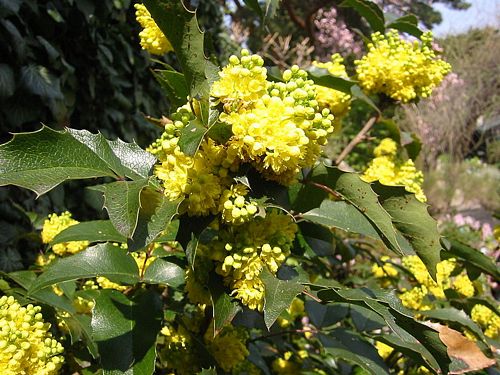
Berberis nervosa commonly known as dwarf Oregon-grape, Cascade Oregon-grape, or dull Oregon-grape, is a flowering plant native to the northwest coast of North America from southern British Columbia south to central California, with an isolated population inland in northern Idaho. It is especially common in second growth, Douglas-fir or Western Redcedar forests, making use of those pools of sunlight that intermittently reach the ground.The plant was collected by Lewis and Clark during their famous expedition to the West before being described for science in 1813.
It is an evergreen shrub with short vertical stems, mostly under 30 cm (12 in), while the leaves reach higher, rarely up to 2 m (6 ft 7 in) tall. The leaves are compound, with 9-19 leaflets; each leaflet is strongly toothed, reminiscent of holly, and somewhat shiny, but less so than tall Oregon-grape. The leaflets do not have a single central vein as in that species, but several veins arranged fan-like, branched from the leaflet base, hence the epithet nervosa. The flowers and fruit are like those of other Oregon-grapes, and are equally bitter-tasting. Some Plateau Indian tribes drank an infusion of the root to treat rheumatism.
Shrub
1 - 7 ft Tall
7 ft Wide
Evergreen

Yellow
Spring
Bank stabilization, Hedge
Partial Shade
Moderate
Max 1x / month once established
Tolerates cold to -15° F
Fast
Prefers well drained acidic soil.
Soil PH: 4.0 - 7.0
For propagating by seed: 3-7 mos. stratification may give satisfactory germination. The following alternative treatment improve germination: 30 days cold, 60 days warm, and 196 days cold stratification. During this last period, remove and pot germinating seeds bimonthly. Some additional germination will occur after the remaining seeds are sown, preferably in a cool location, i.e. outdoors in early spring (McLean 1967). It has been suggested that Berberis nervosa and Berberis pumila need No treatment. if the seeds are kept moist from the time they are cleaned until sown; they should be stored moist (stratified) for 7 mos. in the refrige rator for spring sowing (Eugene Baciu, personal communication 1964).
2, 3, 4*, 5*, 6*, 7*, 8, 9, 10, 14*, 15*, 16*, 17*, 18, 19, 20, 21, 22, 23, 24
Shady canyons and north-facing slopes primarily along the coast from Monterey County northward
Douglas-Fir Forest, North Coastal Coniferous Forest, Redwood Forest
Use with other plants of the north coast such as:
Trees - Redwood (Sequoia sempervirens), Grand Fir (Abies grandi), Maple (Acer spp.), Alder (Alnus spp.), Dogwood (Cornus spp.), Ninebark (Physocarpus capitatus), Pines (Pinus spp.), Willow (Salix spp.), Coast Silktassel (Garrya elliptica), Tanoak (Notholithocarpus densiflorus), Douglas Fir (Pseudotsuga menziesii), Oak (Quercus garryana or kelloggii)
Other companions: Stream Orchid (Epipactis gigantea), Bog Orchid (Platanthera spp.), Oceanspray (Holodicsus discolor), Lily (Lilium spp.), Seep Monkeyflower (Erythranthe guttata), Buttercup (Ranunculus spp.), Gooseberry (Ribes spp.), Yellow-eyed Grass (Sisyrinchium californicum), Hedgenettle (Stachys spp.)
Butterflies and moths supported
0 confirmed and 5 likely
Orange Tortrix Moth
Argyrotaenia franciscana
Barberry Geometer
Coryphista meadii
Fall Webworm
Hyphantria cunea