

Carried by 3 nurseries
View Availability at NurseryData provided by the participants of the Consortium of California Herbaria
View additional distribution information on the Jepson eflora
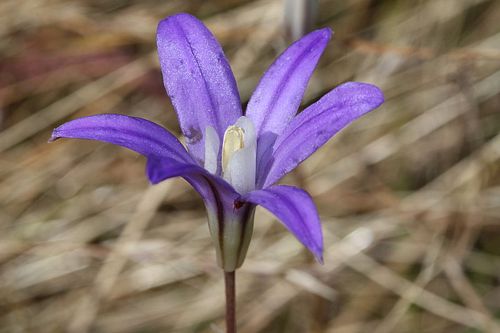
Brodiaea coronaria is the type species of Brodiaea and also known by the common name crown brodiaea. It is native to western North America from British Columbia to northern California, where it grows in mountains and grasslands. This is a perennial herb growing from a corm and producing an erect flower cluster with a few basal leaves. The flower cluster is up to about 25 centimeters tall and bears lilylike flowers on an array of pedicels. Each flower is a tube several centimeters long opening into a bell-shaped corolla of six bright purple lobes each up to 3 centimeters long. In the center are three stamens and whitish sterile stamens known as staminodes. There are two subspecies of this plant. One of them, the Indian Valley brodiaea (ssp. rosea), is a rare pink-flowered subspecies endemic to California.[citation needed] It was first collected by Archibald Menzies during the Vancouver Expedition, and published as Hookera coronaria by Richard Salisbury in his Paradisus Londinensis in 1808. In 1811, James Edward Smith recognised it as belonging to a separate genus, and segregated it into Brodiaea as Brodiaea grandiflora. Smith's genus was accepted, but the priority of Salisbury's specific epithet was also recognised, hence the current name.
Perennial herb, Geophyte
10 in Tall

Blue, Lavender, Purple
Spring
Full Sun
Low, Very Low
Moderate
For propagating by seed: No treatment.
4, 5*, 6, 7*, 9, 14*, 15*, 16*, 17*, 18, 19, 20, 21, 22, 23, 24
Open grassy places, volcanic meadows
Foothill Woodland, Valley Grassland, Yellow Pine Forest, Wetland-Riparian