

Carried by 2 nurseries
View Availability at NurseryData provided by the participants of the Consortium of California Herbaria
View additional distribution information on the Jepson eflora
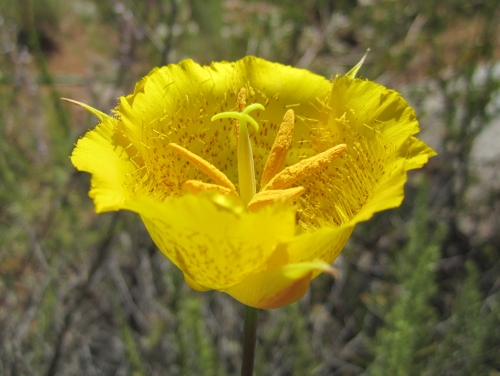
Calochortus weedii is a species of flowering plant in the lily family known by the common name Weed's mariposa lily. It is native to the coast, foothills and mountains of southern California and Baja California, where it is a member of the chaparral flora. It is a perennial herb growing from a bulb, producing a slender, branching stem 30 to 90 centimeters tall. There is a basal leaf up to 40 centimeters long which withers by the time the plant blooms. The flower cluster bears 2 to 6 erect, widely bell-shaped to spreading flowers. Each flower has three narrow sepals and three wider and sometimes shorter petals, each segment up to 3 centimeters long. The petals are oval or wedge-shaped and may be any of a variety of colors, from cream to deep yellow to reddish purple. The petals often have reddish brown borders and flecks, and a coating of hairs on the inner surface. Don't expect it to flower every year. The bulb needs a few years to recover after flowering. The fruit is an angled capsule 4 to 5 centimeters long. There are two recognized varieties; var. intermedius is a rare plant with a more restricted range.
Perennial herb, Geophyte
1 - 3 ft Tall
6 in Wide
Summer Deciduous

Cream, Orange, Purple, Red, Yellow
Spring, Summer
Full Sun
Low, Very Low
Never irrigate once established
Tolerates cold to 0° F
Fast, Medium
Tolerates sand or clay as long as drainage is good.
Soil PH: 6.0 - 7.0
For propagating by seed: No treatment. However, it takes at least 3 years to grow Calochortus bulbs from seed. It is faster to plant bulbs that are a few years old
Dry slopes, canyons and mesas below 4, 000 ft., typically with heavy or rocky soil, usually under low-growing sub-shrubs where the flower can stand above surrounding vegetation.
Chaparral
Use with chaparral shrubs and sub-shrubs such as Lotus (Acmispon spp.), Manzanita (Arctostaphylos spp.), Ceanothus spp., Spice Bush (Cneoridium dumosum), Bush Poppy (Dendromecon rigida), California Encelia (Encelia californica), Brickell Bush (Brickellia californica), Dudleya spp., California Fuchsia (Epilobium canum), Buckwheat (Eriogonum spp.), and various cactus and succulent species
Butterflies and moths supported
0 confirmed and 1 likely
Orange Tortrix Moth
Argyrotaenia franciscana