

Carried by 10 nurseries
View Availability at NurseryData provided by the participants of the Consortium of California Herbaria
View additional distribution information on the Jepson eflora
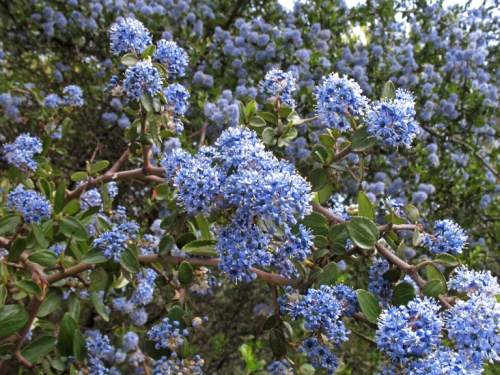
Ceanothus oliganthus is a species of shrub in the buckthorn family Rhamnaceae known by the common name hairy ceanothus. It is endemic to California, where it can be found in most of the coastal mountain ranges in dry habitat such as chaparral. This is a large, erect shrub approaching 3 meters in maximum height. The evergreen leaves are alternately arranged and may be up to 4 centimeters long. They are dark green on top, paler and hairy on the underside, and are edged with hairy teeth. The flower cluster is a cluster or series of clusters of blue or purple flowers. The fruit is a capsule which may be hairy or not, depending on variety. There are three recognized varieties with overlapping ranges. The variety of this species known as jimbrush (var. sorediatus) is sometimes treated as a separate species.
Plant Ceanothus oliganthus on rocky slopes, particular north facing ones in the southern, drier parts of its range. This plant is fairly sensitive to summer water. Best to avoid all direct summer water after it's first year, though it will be happiest if it can stretch its roots out to a damper or irrigated area 10 feet away or so. This plant likes full sun but tolerates part shade.
Shrub
10 ft Tall
12 ft Wide
Mounding
Moderate
Evergreen
Pleasant

Blue, Purple
Winter, Spring
Bank stabilization, Hedge
Full Sun
Very Low
Max 1x / month once established
Moderate
Tolerates cold to 15° F
Fast, Medium
Tolerates both heavy and sandy soils.
Soil PH: 6.0 - 8.0
For propagating by seed: Hot water treatment.
Rocky, dry slopes below 4, 500 ft. most often along the coastal side of the mountains, frequently on north facing aspect, from Humboldt County to San Diego
Chaparral, Foothill Woodland, Yellow Pine Forest
Purple Sage (Salvia leucophylla), Sticky Monkeyflower (Diplacus aurantiacus), California Sagebrush (Artemisia californica), Deerweed (Acmispon glaber), Brittlebush (Encelia spp.), Sage (Salvia spp.), Manzanita (Arctostaphylos spp.), Oaks (Quercus spp.), Lodgepole Pine (Pinus contorta), Ponderosa Pine (Pinus ponderosa), Red Fir (Abies magnifica), Yucca species, native grasses, and Dudleya species
Butterflies and moths supported
4 confirmed and 89 likely
Duskywing
Erynnis afranius
Pacuvius Duskywing
Erynnis pacuvius