

Carried by 4 nurseries
View Availability at NurseryData provided by the participants of the Consortium of California Herbaria
View additional distribution information on the Jepson eflora
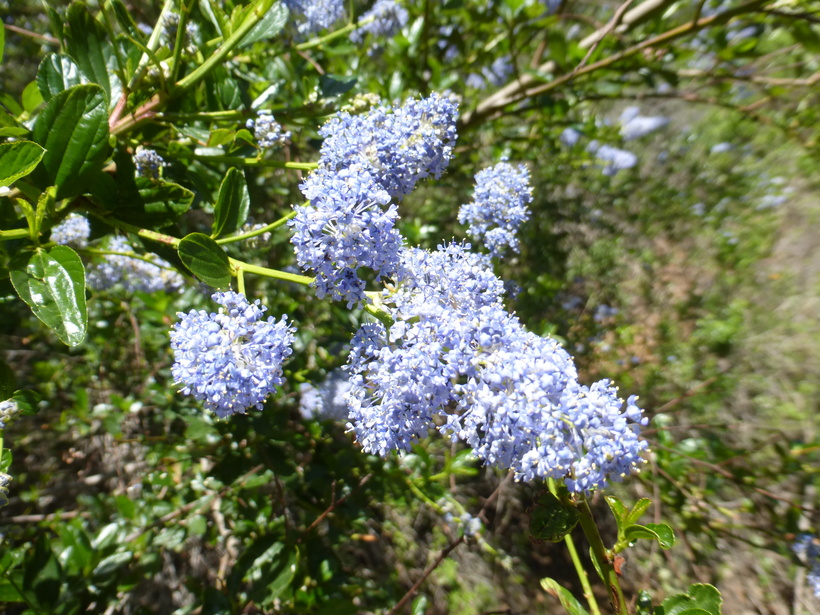
Creeping Blueblossom (Ceanothus thyrsiflorus var. thyrsoflorus) is a the low growing form and variety of the native shrub and tree Ceanothus thyrsiflorus. It native range is coastal central and northern California, extending from northern Santa Barbara County to near the Oregon border, growing 1- 5 miles from the shore. The other variety of this species, Ceanothus thyrsiflorus var. griseus (Carmel Ceanothus) is much more variable in form and is native to habitats closer to the coast.
Creeping Blueblossom was previously classified as Ceanothus thyrsiflorus var. repens.
Creeping Blueblossom has profuse attractive sky blue flowers and makes an excellent ground cover plant. It prefers full sun to part shade in cooler coastal environments, and part shade to full shade in hotter and drier inland environments. It tolerates occasional light summer water, but is quite drought tolerant. It grows well in many different soil types, from clay to sand, and can tolerate poorly draining and fast draining conditions.
Cultivars in the nursery trade include:
Ceanothus thyrsiflorus var. thyrsiflorus 'Taylor's Blue' (Taylors Blue Ceanothus). This is a shrub ground cover growing 2-3 feet tall by 10-15 feet wide. It was introduced in the 1950s as Ceanothus thyrsiflorus 'Louis Edmunds' by the Saratoga Horticultural Foundation, from a plant in nurseryman Ken Taylor's natives garden in Aromas, originally from the garden of nurseryman Louis L. Edmunds. It was previously named and is sometimes still sold as C. t. var. repens 'Taylor's Blue'.
Ceanothus thyrsiflorus var. thyrsiflorus 'Louis Edmunds' (Louis Edmunds Blue Blossom). This is a prostrate ground cover growing 6 inches tall by 6 to 8 feet wide, and is the lowest cultivated form of C. t. var. thyrsiflorus. It introduced by Rancho Santa Ana Botanic Garden (California Botanic Garden) in 1958 as Ceanothus griseus 'Louis Edmunds' from a plant given them by Louis L. Edmunds, who operated the Louis Edmunds Native Plant Nursery in Danville.
This is not the same plant as the cultivar Ceanothus thyrsiflorus var. griseus 'Louis Edmunds' (Louis Edmunds Carmel Ceanothus) nor the formerly named Ceanothus thyrsiflorus 'Louis Edmunds' (currently C. t. var. thyrsiflorus 'Taylors Blue').
Shrub
2 - 3 ft Tall
6 - 10 ft Wide
Mounding, Spreading
Moderate
Evergreen

Blue
Winter, Spring
Groundcover, Bank stabilization
Full Sun, Partial Shade, Deep Shade
Very Low
Never irrigate once established, Irrigate ~ 1x / mo once established, Irrigate ~ 2x / mo once established
Easy
Fast, Medium, Slow
Tolerates sand or clay.
Wooded slopes near the coast
Thrift Seapink (Armeria maritima), Dune Sagewort (Artemisia pycnocephala), Point Reyes Ceanothus (Ceanothus gloriosus), Douglas Iris (Iris douglasiana), California Aster (Corethrogyne filaginifolia), Toyon (Heteromeles arbutifolia), Little Sur Manzanita (Arctostaphylos edmundsii), Western Columbine (Aquilegia formosa), Hooker's Manzanita (Arctostaphylos hookeri), Catalina Cherry (Prunus ilicifolia ssp. lyonii), Sambucus nigra ssp. caerulea, Kinnikinnick (Arctostaphylos uva-ursi), Lemonade Berry (Rhus integrifolia), Morella californica,Lupinus albifrons, Coffeeberry (Frangula californica), Coast Silktassel (Garrya elliptica), Giant Wildrye (Elymus condensatus), Gumweed (Grindelia stricta var. platyphylla), Pajaro Manzanita (Arctostaphylos pajaroensis)
Butterflies and moths supported
0 confirmed and 83 likely
Sallow Button
Acleris hastiana
Cottonwood Dagger Moth
Acronicta lepusculina