

Carried by 8 nurseries
View Availability at NurseryData provided by the participants of the Consortium of California Herbaria
View additional distribution information on the Jepson eflora
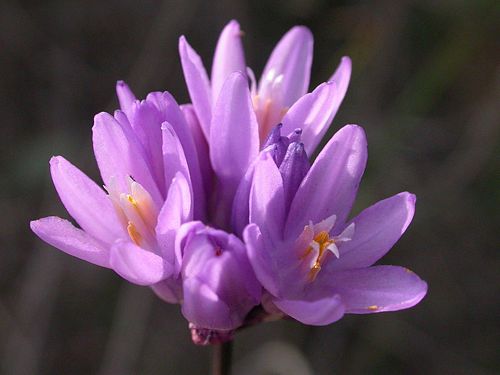
Blue Dicks (Dipterostemon capitatus), also called Wild Hyacinth, Purplehead and Brodiaea (alternate spellings, Brodiea, Brodeia) occur in Arizona, California, Oregon, Utah, New Mexico, and northern Mexico.
This species has three recognized subspecies: D. capitatus subsp. lacuna-vernalis, Dipterostemon capitatus subsp. capitatus, and Dipterostemon capitatum subsp. pauciflorus. Dipterostemon capitatus is an herbaceous perennial, growing from an underground corm. It has 2 or 3 leaves, which are 4-16 inches long.
The flower cluster is head- or umbel-like, and dense. It usually contains 2 to 15 flowers, which have a blue, blue-purple, pink-purple, or white perianth. The flower tube is 0.1-0.5 inch and is narrowly cylindrical to bell-shaped. Flowers have six fertile stamens, deeply notched, lance-shaped, white, angled inward, slightly reflexed at tip, with outer filaments wider at the base. It has a twisted and fleshy peduncle, a set of membranous, petal-like stamen appendages around the anthers, and angular black seeds.
It reproduces from seed and vegetative means in the form of cormlets. The cormlets are attached to the parent corm by stolons and are sessile, produced in the axils of the old leaf bases on the mature corm. Plants thrive in open disturbed environments and are a common post-fire succession species in chaparral.
Perennial herb
2 ft Tall
2 in Wide
Upright Columnar
Moderate
Summer Deciduous
Slight

Lavender, Blue
Winter, Spring
Groundcover, Deer resistant
Full Sun, Partial Shade
Low
Never irrigate once established
Moderate
Tolerates cold to -20° F
Fast, Medium, Slow
Adaptable.
The offsets from the corms can be removed and replanted elsewhere. The seeds also germinate relatively well in open soil that has no weeds and minimal mulch. Corms are often available from specialty bulb vendors or CNPS plant sales.
Open places, meadows, grassy places, openings in mixed chaparral or coastal sage scrub on rocky slopes, canyons and mesas. Also found in desert transition zone.
Chaparral, Coastal Scrub, Creosote Bush Scrub, Lowland Chaparral, Maritime Desert Scrub, Meadows, Perennial Grassland--Desert Grassland, Perennial Grassland--Remnant Non-desert Grassland, Southern Coastal Scrub
Native grasses, Calochortus spp., Coast Sagebush, Chamise (Adenostoma fasciculatum var. fasciculatum), Sugar Bush (Rhus ovata), Yucca spp., Dudleya spp., various cactus species