

Carried by 5 nurseries
View Availability at NurseryData provided by the participants of the Consortium of California Herbaria
View additional distribution information on the Jepson eflora
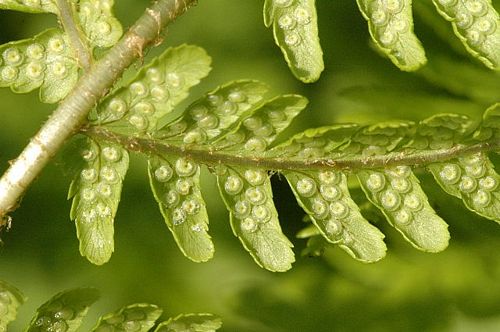
Dryopteris filix-mas (Common Male Fern or Male Fern) is one of the most common ferns of the temperate Northern Hemisphere, occurring throughout much of Europe, Asia, and North America. It favours damp shaded areas and is common in the understory of woodlands, but is also found in shady places on hedge-banks, rocks, and screes. It is much less abundant in North America than in Europe. The half-evergreen leaves have an upright habit and reach a maximum length of 1.5 meter, with a single crown on each rootstock. The bipinnate leaves consist of 20-35 pinnae on each side of the rachis. The leaves taper at both ends, with the basal pinnae about half the length of the middle pinnae. The pinules are rather blunt and equally lobed all around. The stalks are covered with orange-brown scales. On the abaxial surface of the mature blade 5 to 6 sori develop in two rows. When the spores ripen in August to November, the indusium starts to shrivel, leading to the release of the spores.
Fern
2 ft Tall
Evergreen
Containers
Full Sun
Moderate
Moderate
Fast, Medium, Slow
Tolerant of a variety of garden soils as long as sufficient moisture is available.
Granitic cliffs
Pinyon-Juniper Woodland
Butterflies and moths supported
0 confirmed and 1 likely
Orange Tortrix Moth
Argyrotaenia franciscana