

Carried by 0 nurseries
View Availability at NurseryData provided by the participants of the Consortium of California Herbaria
View additional distribution information on the Jepson eflora
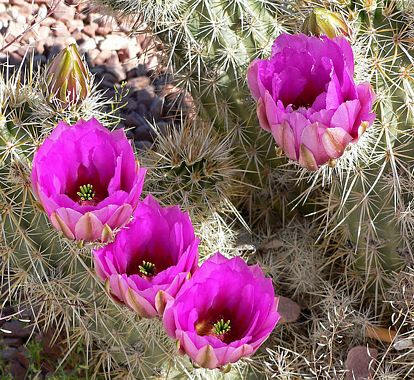
The Calico Cactus (Echinocereus engelmannii) is commonly found in desert areas of the southwestern United States and the adjacent areas of Mexico, including the states of California, Nevada, Utah, Arizona, Baja California and Sonora. In California it is found in the lower Colorado and Mojave deserts. There are five recognized varieties in the state. Calico Cactus grows in clusters, sometimes up to 20 and more stems. Its bright magenta flowers bloom in April in its southern extremes to late May at northern locations. The flowers are borne at the upper half to one third of the stem. They are funnelform in shape, up to 3.5 inches long with dark-green stigmas. The fruit is very spiny. At first it is green, becoming pink and drying when ripe. The ripe fruit has spines which are easily detached. The seeds are black, and around a tenth of an inch in size. The stems are initially cylindrical and erect in young plants, but later with the stem base lying on the ground. The stems are usually 1.5 to 3.5 inches in diameter and up to 25 inches high, and obscured by heavy spines which tend to angle downwards. The plants have around 10 ribs, which are somewhat flattened and tuberculate. It is not often used, even in desert gardens, because it is very slow growing and tends to not flower until it has reached mature size. Nevertheless, the flowers are a beautiful reward for the patient desert gardener.
Shrub, Succulent
3 - 24 in Tall
4 ft Wide
Slow
Evergreen

Purple
Spring
Containers, Deer resistant
Full Sun
Extremely Low, Very Low
Max 1x / month once established
Moderate
Fast
Rocky, sandy.
2, 3, 7, 10, 11, 12, 13, 14, 15, 16, 17, 18, 19, 20, 21, 22, 23, 24
Most often found on rocky desert slopes, sometimes growing out of cracks in large boulders
Creosote Bush Scrub, Joshua Tree Woodland, Pinyon-Juniper Woodland
Use with other desert or desert-edge species such as Indian Mallow (Abutilon palmeri), Desert Agave (Agave deserti), Desert Lavender (Condea emoryi), Cholla Cactus (Cylindropuntia spp.), Brittlebush (Encelia farinosa), Barrel Cactus (Ferocactus cylindraceus), Ocotillo (Fouquieria splendens), Chuparosa (Justicia californica), Prickly Pear Cactus (Opuntia spp.), Jojoba (Simmondsia chinensis), Apricot Mallow (Sphaeralcea ambigua), and Mojave Yucca (Yucca shidigera), as well as various desert annuals.
Butterflies and moths supported
0 confirmed and 2 likely
Yosemitia Graciella
Yosemitia graciella