

Carried by 75 nurseries
View Availability at NurseryData provided by the participants of the Consortium of California Herbaria
View additional distribution information on the Jepson eflora
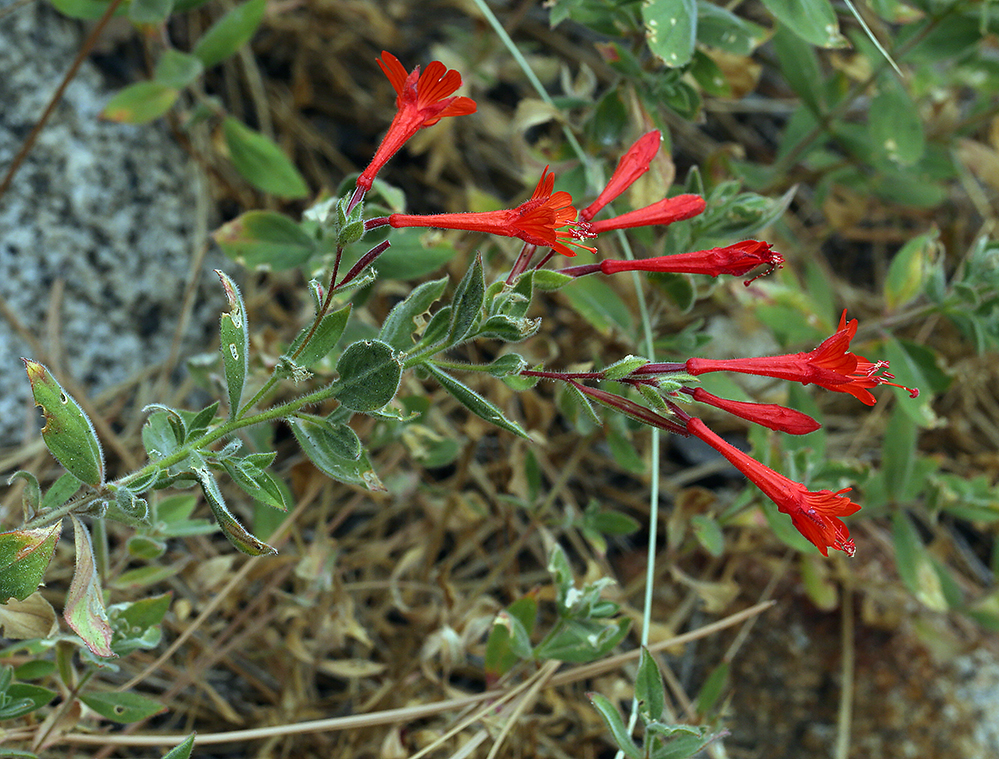
California Fuchsia (Epilobium canum) is a beautiful species of willowherb, native to the California foothills and coastal areas. It is a perennial plant, notable for the profusion of bright scarlet flowers in summer and autumn --- it's frequently the only native California plant in an area flowering at the height of summer. They tend to die back and go dormant in the winter.
Other common names include California Fuchsia (from the resemblance of the flowers to those of Fuchsias), Hummingbird Flower, and Hummingbird Trumpet (as the flowers are very attractive to hummingbirds).
California Fuchsia is often found by seasonal creeks, seeps and spring, particularly in the drier southern part of its range.
California Fuchsia is easy to grow. It does best and will flower most profusely in full sun. In the wetter, northern part of its range or near the coast, this plant will typically require no supplemental water after established. In the drier, hotter, inland southern areas, it will often die without summer water unless planted close to an irrigated or other wet area. You can water it 1x/month without much danger.
Plants tend to get straggly after flowering by late fall or early winter. Best to cut it back to the ground as soon as the flowers are spent, and it will come back back lush and healthy in the spring. Otherwise, it will look straggly and unhealthy the next year and is more likely to die.
This plant will readily self-seed, so once you get this species established, it will usually start springing up around your garden. It also spreads by rhizomes. There's probably no better California native plant for attracting hummingbirds.
This plant is on several fire-resistant plant lists, including FireSafe Marin and County of San Diego.
Perennial herb
3 - 18 in Tall
2 - 3 ft Wide
Spreading
Fast
Winter Semi-deciduous
None

Red
Summer, Fall
Containers, Deer resistant, Groundcover
Full Sun, Partial Shade
Very Low, Low
Max 1x / month once established
Easy
Tolerates cold to 0° F
Fast, Medium, Slow
Tolerates clay and sand.
Tolerates serpentine soil..
Soil PH: 6.0 - 8.0
Cut or mow to base in fall or early winter to stimulate for new growth. Unwanted rhizomes can be pulled at any time.
Self-seeds readily. Rhizomes can be transplanted in winter or spring.
This species is found in a number of natural settings over a large part of the state. Near the coast, it is found on slopes, bluffs or canyons as part of chaparral or coastal scrub. In more inland areas including the Sierra, it is found in slightly damper slopes and flats, often near seasonal creeks, often as part of pine or fir forest.
Chaparral, Coastal Sage Scrub, Lodgepole Forest, Oak Woodland, Pinyon-Juniper Woodland, Red Fir Forest, Subalpine Forest, Yellow Pine Forest
Milkweed (Asclepias spp.), Giant Wild Rye (Elymus condensatus), Sand Aster (Corethrogyne filaginifolia), Sagebrush (Artemisia californica), Monkeyflower (Mimulus spp.), Encelia californica, Buckwheat (Eriogonum spp.), Heartleaf Keckiella (Keckiella cordifolia), Penstemon species, Salvia species, Blue-eyed Grass (Sisyrinchium bellum)
Butterflies and moths supported
0 confirmed and 15 likely
Fireweed Clearwing
Albuna pyramidalis
Langston's Forester
Alypia langtoni
Black-Banded Carpet
Antepirrhoe semiatrata