

Carried by 1 nurseries
View Availability at NurseryData provided by the participants of the Consortium of California Herbaria
View additional distribution information on the Jepson eflora
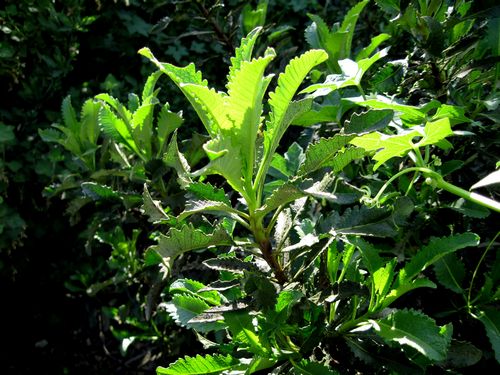
Eriodictyon trichocalyx is a species of flowering plant in the Boraginaceae (Forget-me-not) family known by the common name I is native to southern California and Baja California where it grows in several habitat types, including chaparral and grassland There are two recognized varieties with different ranges - var. lanatum is restricted to the Peninsular Range of San Diego County. Var. trichocalyx is restricted to the Transverse Range. It is a shrub growing erect up to about 2 meters tall, with lance-shaped to oval leaves up to 14 centimeters long. They are hairless and resinous to densely woolly. The inflorescence is a cluster of white to light purple bell-shaped flowers. A closely related species is Thick-leaf Yerba Santa (E. crassifolium) which is somewhat more common in chaparral. All members of this genus are valuable nectar plants for butterflies.yerba san. It is native to southern California and Baja California, where it grows in several habitat types, including chaparral and grassland. It is a shrub growing erect up to about 2 meters tall, with lance-shaped to oval leaves up to 14 centimeters long. The flowers of E. t. var. lanatum are white to light purple.
Shrub
3 - 7 ft Tall
2 - 6 ft Wide
Upright
Fast
Evergreen

White, Purple
Spring
Bank stabilization, Hedge
Partial Shade, Full Sun
Very Low
Max 2x / month once established
Tolerates cold to 0° F
Fast
Typically sandy or decomposed granite.
Soil PH: 6.0 - 7.2
For propagating by seed: Oven heat of 194°F for 5 ruins. (Went et al. 1952). Alternative treatment for Eriodictvon species: soak seeds 24 hrs. in 1000 ppm potassium gibberellate ("Gibrel" growth substance; Merck & Co., Chem. Div. Rahway, n.J.J, then sow or dry and store in refrigerator for up to 6 mos. before spring (Francis Ching, personal communication 1962).
Slopes, mesas, ravines, grassy places in dry mountain and desert transition zone
Chaparral, Joshua Tree Woodland, Pinyon-Juniper Woodland, Yellow Pine Forest
This plant is best used in arid mountain or high desert gardens.
Trees: Joshua Tree (Yucca brevifolia), California Fan Palm (Washingtonia filifera), Blue Paloverde (Parkinsonia florida), Pinyon Pine (Pinus edulis or monophylla), California Juniper (Juniperus californica), and Yellow Pine (Pinus ponderosa)
Other Plants: Desert Willow (Chilopsis linearis),, Creosote Bush (Larrea tridentata), Ocotillo (Fouquieria splendens), Jojoba (Simmondsia chinensis), White Bursage (Ambrosia dumosa), Chuparosa (Justicia californica), Barrel Cactus (Ferocactus cylindraceus), Desert Agave (Agave deserti), Brittlebush (Encelia farinosa), Apricot Mallow (Sphaeralcea ambigua), Desert Lavendar (Condea emoryi), and various cactus species, or with any chaparral plantsand various cactus species, or with any chaparral plants
Butterflies and moths supported
1 confirmed and 2 likely
Fruit-Tree Leafroller Moth
Archips argyrospila
Orange Tortrix Moth
Argyrotaenia franciscana