

Carried by 3 nurseries
View Availability at NurseryData provided by the participants of the Consortium of California Herbaria
View additional distribution information on the Jepson eflora
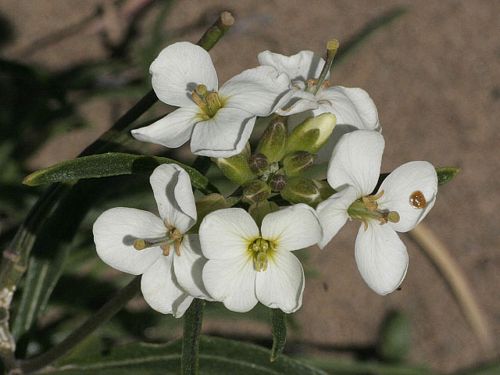
Erysimum franciscanum, commonly known as the Franciscan Wallflower or San Francisco Wallflower, is a plant endemic to the northern California coast, from Sonoma to Santa Cruz County. It is a member of the wallflower genus in the mustard family, the Brassicaceae. The plant is a biennial or short-lived perennial. The flowers are cream-colored, with four sepals and four petals arranged in a cross shape, as is characteristic of the Brassicaceae. It is usually reported to flower from February to April, but can be seen in flower as early as January and as late as June, depending on the site. The plant is delicate-looking; it prefers open scrubby areas with a fair amount of sunlight, but can flourish on a range of soils including disintegrating serpentine, gravelly and sandy soils. It is fairly easily cultivated in gardens.
Annual herb, Perennial herb
2 - 20 in Tall
Evergreen

White, Cream
Spring, Winter
Deer resistant
Full Sun
Low
For propagating by seed: No treatment.
5, 7, 14, 15*, 16*, 17*, 19*, 20*, 21*, 22*, 23*, 24*
Open places
Coastal Strand, Northern Coastal Scrub, Valley Grassland
Butterflies and moths supported
0 confirmed and 2 likely
Sara Orangetip
Anthocharis sara
Large Marble
Euchloe ausonides