

Carried by 10 nurseries
View Availability at NurseryData provided by the participants of the Consortium of California Herbaria
View additional distribution information on the Jepson eflora
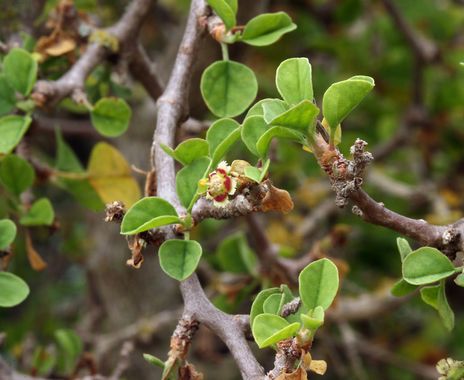
Euphorbia misera is a species in the Euphorbiaceae (Spurge) family known by the common name Cliff Spurge. It is native to southern California and Baja California, where it is known from the Sonoran Desert and the coastline, including the Channel Islands of California. It occurs in close proximity to the coast in Coastal Sage Scrub and Maritime Succulent Scrub vegetation, often on steep slopes. Although common in Baja, it is very rare in California. It was probably never common north of the border, and much of its former habitat has been lost to agriculture and urbanization.
This is a subshrub standing erect in protected areas, or prostrate when exposed to constant sea breeze. It reaches one half to one meter in height. The stems are limber and somewhat succulent. When broken, the stems produce a milky sap that is typical of Euphorbias. It has small, rounded, hairy leaves that are dropped readily in dry periods. The typical Euphorbia flower clusters are at the tips of the branches. The distinctive flower is hairy and has a central nectar disc with a bright red appendage with scalloped edges and a light yellow fringe. The style in the pistillate flower extends outward and is divided at the tip. The anthers are bright yellow. The fruit is a spherical capsule with lobes containing round, wrinkled gray seeds.
In the garden this plant can be a highly interesting though unusual specimen or accent plant. The flowers are not showy, but in garden conditions the plant can bloom nine months out of the year. It is especially effective with other succulents and decorative rock. It is best used in warm, relatively dry coastal gardens in the southern part of the state.
Shrub
2 - 3 ft Tall
3 ft Wide
Moderate
Summer Semi-deciduous
None

Red, Yellow, White
Summer, Spring, Winter
Containers
Full Sun
Very Low, Low
Max 1x / month once established
Moderate
Tolerates cold to 30° F
Fast, Medium
Prefers sandy/rocky soil.
Soil PH: 6.0 - 7.0
Can be tip pruned in fall. Use caution to avoid getting sap in eyes.
By seed or cuttings. Mature plants may produce seedlings in the vicinity of the mother plant. These can be left alone or dug up and transplanted.
Rocky slopes, sandstone sea bluffs and arroyos below 1, 600 ft.
Coastal Sage Scrub
Most effective when used with other succulents, shrubs and herbs of the south coast, including Shaw's Agave (Agave shawii), Chalk Dudleya (Dudleya pulverulenta), Fingertips (Dudleya edulis), Giant Chalk Dudleya (Dudleya brittonii - a Baja species), California Encelia (Encelia californica), California Sagebrush (Artemisia californica), Chaparral Yucca (Hesperoyucca whipplei), Mojave Yucca (Yucca shidigera), Coast Barrel Cactus (Ferocactus viridescens), Prickly Pear Cactus (Opuntia spp.), Coast Cholla (Cylindropuntia prolifera), Fish Hook Cactus (Mammillaria dioica), and California Boxthorn (Lycium californicum)
Butterflies and moths supported
0 confirmed and 1 likely
Straight-Lined Wave
Lobocleta plemyraria