

Carried by 0 nurseries
View Availability at NurseryData provided by the participants of the Consortium of California Herbaria
View additional distribution information on the Jepson eflora
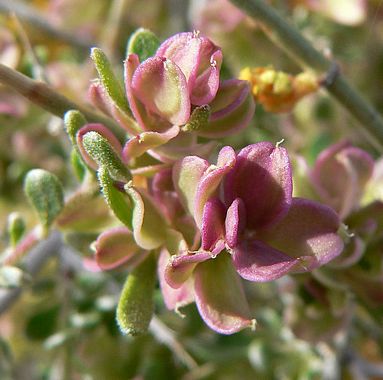
Grayia is a monotypic genus of plants containing the sole species Grayia spinosa, which is known by the common names hop sage and spiny hop sage. This plant is widely distributed across the western United States, where it grows in a number of desert and mountain habitats. It is a small, multibranched, brambly shrub generally under a meter in height. The grayish branches have spiny, pointed ends and stiff twigs. During the growing season the branches are covered in small oval-shaped, flat to scooplike leaves mostly under 3 centimeters in length. The shrub is dioecious, with male individuals flowering in clumps of a few flowers surrounded by leaflike leafs, and female individuals producing flower clusters of bright pink, yellow, or white fruiting leafs surrounding tiny petalless pistillate flowers. Female flower clusters are much larger than male and make the plant one of the more colorful shrubs in the springtime habitat. The fruit is a utricle only a few millimeters wide. The shrub sheds its leaves and flowers by the summer in hot or dry areas and becomes a woody gray thicket; it is evergreen in some regions. The genus was named after the botanist Asa Gray.
Shrub
2 - 3 ft Tall
Upright
Slow
Evergreen

Red, Pink, Cream, Yellow, White
Spring
Full Sun, Partial Shade
Low
Moderate
Fast
Adaptable, tolerant of sand, loam and clay.
For propagating by seed: No treatment; best germination occurs at 41°F constant. Wide diurnal fluctuation from 50° to 86°F also gives good germination ( Heit 1971). Two to 3 mos. stratification may also give good results.
Sandy gravelly places
Creosote Bush Scrub, Pinyon-Juniper Woodland
Butterflies and moths supported
1 confirmed and 0 likely