

Carried by 11 nurseries
View Availability at NurseryData provided by the participants of the Consortium of California Herbaria
View additional distribution information on the Jepson eflora
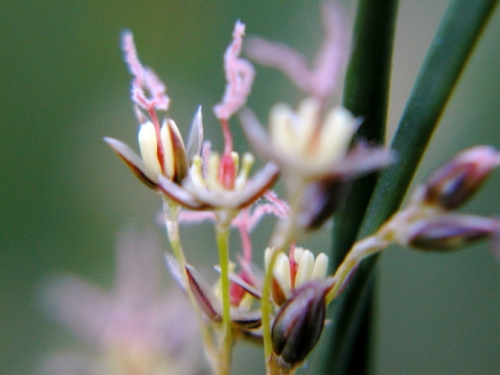
Juncus mexicanus (Mexican Rush) is native to the southwestern quadrant of the United States and parts of Mexico and Central and South America. It is a plant of moist areas in a great number of habitats, from coast to desert to mountain and from sea level to 10,000 ft. It may be found in standing water or saturated soil. This is a rhizomatous perennial herb which varies in appearance. The thin erect stems reach a maximum height anywhere from 10 to 80 centimeters. The leaves grow from the base of the stem and can exceed 20 centimeters in length. The flower cluster usually sprouts from the side of the stem rather than the tip. The flowers grow on long peduncles. Each individual flower has thick petals with longitudinal stripes which vary in color from bright to dark. It has six stamens with very large anthers, and long stigmas. This species is sometimes treated as a variant of Juncus arcticus or Juncus balticus.
Grass
4 - 31 in Tall
Upright
Fast, Moderate
Evergreen, Summer Semi-deciduous
None

Green, Brown
Spring
Partial Shade
Moderate
Keep moist
Tolerates cold to 15° F
Slow, Standing
Tolerates any soil as long as adequate moisture is present.
Soil PH: 5.0 - 8.0
Found is boggy or marshy locations throughout the state
Alpine Fell-Fields, Chaparral, Foothill Woodland, Lodgepole Forest, Red Fir Forest, Subalpine Forest, Valley Grassland, Yellow Pine Forest, Wetland-Riparian
Due to its spreading tendency, use with caution in garden ponds or bioswales. Use with other marsh plants such as Carex spp., Spikerush (Eleocharis spp.), Rush (Juncus spp.), Saltmarsh Fleabane (Pluchea odorata), Arrowhead (Sagittaria spp.), Willow (Salix spp.), Hedgenettle (Stachys bullata), and Cattail (Typha spp.)
Butterflies and moths supported
0 confirmed and 7 likely
Mottled Marble
Bactra furfurana
Javelin Moth
Bactra verutana
Yellow Sedge Borer
Capsula subflava
Yellow-Collared Scape Moth
Cisseps fulvicollis