

Carried by 2 nurseries
View Availability at NurseryData provided by the participants of the Consortium of California Herbaria
View additional distribution information on the Jepson eflora
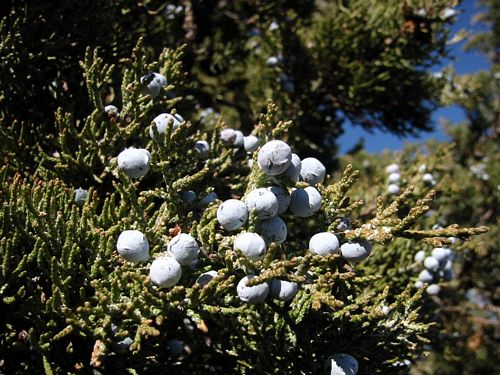
Juniperus occidentalis (Western Juniper and Sierra Juniper) is a shrub or tree in the Cupressaceae family native to the western United States, growing in mountains at altitudes of 800-3,000 meter (rarely down to 100 meter). The shoots are of moderate thickness among junipers, 1-1.6 millimeter diameter. The leaves are arranged in opposite decussate pairs or whorls of three; the adult leaves are scale-like, 1-2 millimeter long (to 5 millimeter on lead shoots) and 1-1.5 millimeter broad. The juvenile leaves (on young seedlings only) are needle-like, 5-10 millimeter long. The cones are berry-like, 5-10 millimeter in diameter, blue-brown with a whitish waxy bloom, and contain one to three seeds; they are mature in about 18 months. The male cones are 2-4 millimeter long, and shed their pollen in early spring. Western Juniper is slow growing; large trees are very old. In the garden it should be treated as a shrub.
Tree
25 - 49 ft Tall
Upright
Slow

Yellow
Spring
Full Sun, Partial Shade
Low, Moderate
Prefers sandy or loamy soils. Does not grow well in clay soils.
Prune in winter when wood boring insects are less active.
1*, 2*, 3*, 4, 5, 6*, 7*, 8, 9, 10, 14*, 15, 16, 17, 18, 19, 20, 21, 22, 23, 24
Dry slopes and flats
Lodgepole Forest, Northern Juniper Woodland, Red Fir Forest, Yellow Pine Forest
Use with forest and woodland shrubs such as Manzanita (Arctostaphylos spp.), Big Sagebrush (Artemisia tridentata), Ceanothus spp., Dogwood (Cornus spp.), Red Buckthorn (Frangula rubra), Antelope Bush (Purshia tridentata), Huckleberry Oak (Quercus vaccinifolium), Currant (Ribes spp.), Labrador Tea (Rhododendron columbianum), and Desert Sage (Salvia dorrii)
Butterflies and moths supported
0 confirmed and 22 likely
The Brown Elfin
Callophrys augustinus
Olive Hairstreak
Callophrys gryneus
Sugar Pine Tortrix Moth
Choristoneura lambertiana