

Carried by 8 nurseries
View Availability at NurseryData provided by the participants of the Consortium of California Herbaria
View additional distribution information on the Jepson eflora
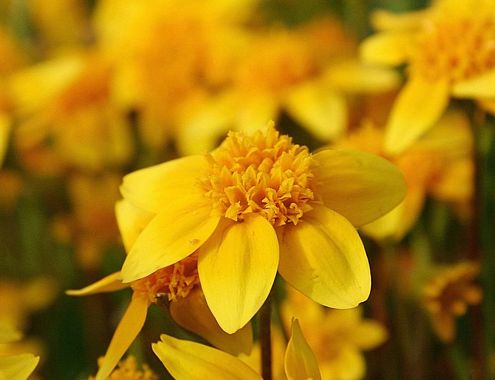
California Goldfields (Lasthenia californica) is a widespread species of flowering plant in the Asteraceae (Sunflower) family, among a number of species in the genus Lasthenia, all known by the common name goldfields. This species is native to a large part of California, Oregon, and surrounding areas, where it is a very common member of the flora in a number of habitat types.
This is an annual herb is quite variable in appearance across locations and climates. The leaves are hairy, somewhat linear in shape. Individuals growing along the coast may have fleshy leaves.
Atop the hairy stems are flower clusters of flower heads with hairy phyllaries (leaf-like structures at the base of the flower). The head contains many yellow disc florets with a fringe of small ray florets. Large populations of this species bloom at one time in the spring, producing the carpets of yellow on hillsides and in meadows that give the plant its common name. In the garden, it is most often grown from seed, which germinates readily.
Annual herb
6 - 16 in Tall
6 in Wide
Fast

Yellow
Winter, Spring
Containers
Partial Shade, Full Sun
Very Low, Low
Max 2x / month once established
Moderate
Medium
Variable.
By seed
7*, 8*, 9*, 10*, 11, 12, 14*, 15*, 16*, 17*, 18*, 19*, 20*, 21*, 22*, 23*, 24*
Many settings including coastal prarie, meadows, flats, native grasslands, damp areas, woodland understory, along the immediate coast, Coast Ranges, and Sierra foothills
Coastal Prairie, Coastal Sage Scrub, Foothill Woodland, Northern Coastal Scrub, Northern Oak Woodland, Valley Grassland
Goldfields occurs with many other plants, but in the garden it is best used in a dense patch with other annuals such as Blue Gilia (Gilia capitata), Baby Blue-eyes (Nemophila menziesii), Clarkia spp., Lupines (Lupinus spp.), Checkerbloom (Sidalcea spp.), as well as succulents such as Dudleya spp. and Sedum spp.
Butterflies and moths supported
0 confirmed and 1 likely
Small Heliothodes Moth
Heliothodes diminutivus