

Carried by 1 nurseries
View Availability at NurseryData provided by the participants of the Consortium of California Herbaria
View additional distribution information on the Jepson eflora
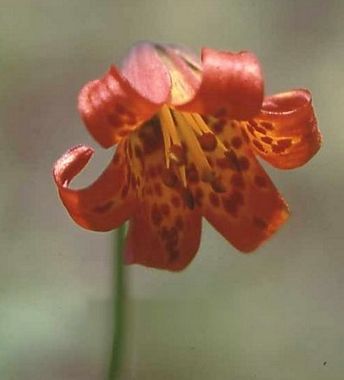
Lilium maritimum is a species of lily known by the common name coast lily. It is endemic to California, where it is known only from the coastline north of San Francisco. It occurred south of San Francisco in the past; these occurrences have all been extirpated. It is now restricted to the North Coast, particularly in Mendocino County, where it grows in coastal prairie habitat, coniferous forests, and bogs amongst Drosera species. This is a perennial herb usually exceeding a meter in height and known to exceed two meters at times. Specimens from coastal bluffs and similar harsh habitat are much smaller. The plant grows from a scaly, elongated bulb several centimeters long. The oval leaves are mostly basal, with some located in several whorls about the stem. They may reach 18 centimeters long. The flower cluster bears up to 13 large, nodding lily flowers. The flower is bell-shaped with 6 petals with tips recurved or curled tightly back. The petals are up to 5 centimeters long and red to orange, usually with spots. There are 6 stamens with large red anthers sometimes over a centimeter long, and a pistil which may be over 3 centimeters in length. The flowers are pollinated by Allen's and Anna's Hummingbirds when first open, and later by bumblebees (Bombus spp.).
Perennial herb, Geophyte
3 - 8 ft Tall

Orange, Red
Spring, Summer
Full Sun, Partial Shade
Moderate
Moderate
Fast, Medium, Slow, Standing
.
Soil PH: 4.3 - 5.8
For propagating by seed: Sow outdoors in summer for germination the following spring, or 3-6 mos. warm then 2-3 mos. cold stratification. For forcing slightly green or fresh seeds: 6-8 wks. warm (70°F) stratification or until the majority of seeds have formed bulblets; then 4-6 wks. cold (about 35°FJ stratification; sow, and at 55 to 60°F leaves should be produced in 4-6 wks. (De Graaff 1951).
Bogs and open places
Closed-cone Pine Forest, Coastal Prairie, Mixed Evergreen Forest, North Coastal Coniferous Forest, Northern Coastal Scrub, Wetland-Riparian
Butterflies and moths supported
0 confirmed and 3 likely
Reaper Dart
Euxoa messoria
Figwort Stem Borer
Papaipema sauzalitae
Virginian Tiger Moth
Spilosoma virginica