

Carried by 1 nurseries
View Availability at NurseryData provided by the participants of the Consortium of California Herbaria
View additional distribution information on the Jepson eflora
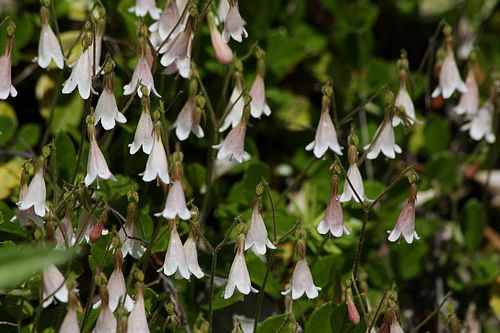
Linnaea borealis, commonly known as Twinflower (sometimes written twin flower) is a woodland subshrub, treated either in the family Caprifoliaceae, or sometimes in its own family Linnaeaceae. The stems are slender, hairy and prostrate, growing to 20-40 centimeter long, with opposite evergreen rounded oval leaves 3-10 millimeter long and 2-7 millimeter broad. The flowering stems curve erect, to 4-8 centimeter tall, leafless except at the base; the flowers are paired, pendulous, 7-12 millimeter long, pale pink with a five-lobed corolla. It has a circumpolar distribution in moist subarctic to cool temperate forests, extending further south at high altitudes in mountains, in Europe south to the Alps, in Asia south to northern Japan, and North America south to northern California and Arizona in the west, and Tennessee in the Appalachian Mountains in the east. In Great Britain, the twinflower grows in mainly open pine woodlands in Scotland and northernmost England. Foresters consider this plant to be an indicator species of ancient woodlands, often found in association with Creeping Lady's Tresses. It is listed as "nationally scarce". It is found in about 50 sites around the country, with most situated in the woods around the Cairngorms; the southernmost locations are four sites in Northumberland and one in County Durham. The sparseness of the sites is responsible for the continued decline of the flower in the country.
Plant type
Perennial herb
Size
2 - 8 in Tall
3 ft Wide
Form
Spreading
Growth rate
Very Slow
Dormancy
Evergreen
Fragrance
Pleasant

Color
Pink
Special uses
Groundcover
Sun
Deep Shade, Partial Shade
Summer irrigation
Max 1x / month once established
Cold tolerance
Tolerates cold to 5° F
Soil description
Moist, acidic soil.
Soil PH: 5 - 6
Propagation
Most effective way to propagate this plant is through stem cuttings (late spring) or by layering as seeds can be difficult to collect and seed germination rate is quite low. With cuttings, divide young, rooted runners and carefully detach from parent plant.
Site type
Moist places
Plant communities
Lodgepole Forest, Mixed Evergreen Forest, Red Fir Forest, Subalpine Forest, Yellow Pine Forest, Wetland-Riparian
Plant with other associated forest species, such as Cascara Sagrada (Frangula purshiana), Western Azalea (Rhododendron occidentale), Western Brakenfern (Pteridium aquilinum), and Bigflower Tellima (Tellima grandiflora).
Common names:
Visit About Us for general information about our data sources and terms of use.