

Carried by 3 nurseries
View Availability at NurseryData provided by the participants of the Consortium of California Herbaria
View additional distribution information on the Jepson eflora
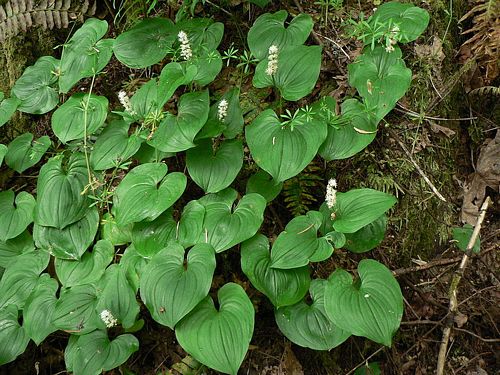
Maianthemum dilatatum (Two-leaved Solomon's Seal or False Lily of the Valley) is a common rhizomatous perennial flowering plant in the Ruscaceae Butcher's Broom) family. It is native to western North America from northern California to the Aleutian islands, and Asia across the Kamchatka Peninsula, Japan, and Korea. It grows in coastal temperate rainforests, and is often the dominant groundcover plant in Sitka Spruce forests. The plant produces an erect, unbranched stem up to about 40 centimeters tall. A non-flowering shoot bears one smooth, waxy, shiny leaf up to 10 centimeters long and 5 to 8 broad, hence its scientific name (dilatatum means 'broad'). On plants that are flowering, 2 or 3 leaves are produced oppositely on the stems. The leaf is oval in shape with a heart-shaped base. Although it can be a vigorous spreader where conditions are right (shady and damp), it makes a good groundcover for shady northern gardens.
Perennial herb
1 ft Tall
Evergreen

White
Spring
Groundcover
Deep Shade, Partial Shade
High, Moderate
Max 1x / week once established
Tolerates cold to 15° F
Fast
Prefers rich, loose, but well-drained soils with lots of humus.
Soil PH: 4.5 - 7.5
4*, 5*, 6, 7, 14, 15*, 16*, 17*, 24
Moist, shady evergreen forests
Closed-cone Pine Forest, Mixed Evergreen Forest, Forest, Wetland-Riparian
This plant is best used in a damp shade garden with similar plants such as Heuchera spp., ferns, Meadow Rue (Thalictrum spp.), Western Dichondra (Dichondra occidentalis), Wild Ginger (Asarum spp.), and Brook Foam (Boykinia occidentalis)
Butterflies and moths supported
0 confirmed and 1 likely
American Angle Shades
Euplexia benesimilis