

Carried by 0 nurseries
View Availability at NurseryData provided by the participants of the Consortium of California Herbaria
View additional distribution information on the Jepson eflora
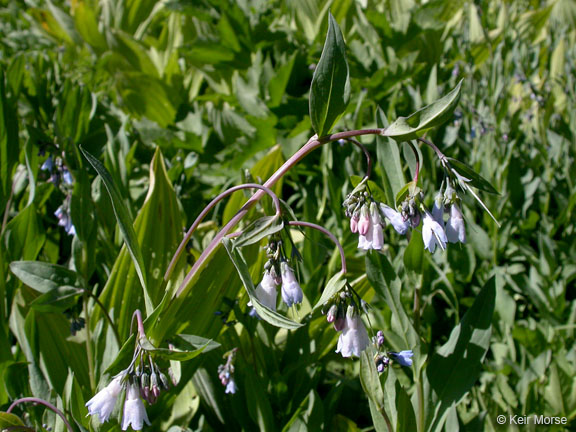
Mertensia ciliata is a species of flowering plant in the borage family known by the common names tall fringed bluebells, mountain bluebells, and streamside bluebells. It is native to the western United States, in California, Nevada, Utah, and Oregon. It often grows in moist habitat, such as subalpine meadows and creeksides. It often carpets large areas of meadow and hillside with blue-green foliage and sweet-scented bluebell blooms. Mertensia ciliata is a perennial herb producing a cluster of erect stems from a thick, branching caudex. The leafy stems reach well over a meter in maximum height. The veiny leaves are oval to lance-shaped and pointed. The inflorescence is an open array of many clustered blue bell-shaped flowers each between 1 and 2 centimeters long. The hanging, fragrant flower is tubular, expanding into a wider, lobed mouth. The flowers and leaves are edible. Mertensia ciliata is a perennial herb producing a cluster of erect stems from a thick, branching caudex. The leafy stems reach well over a meter in maximum height. The veiny leaves are oval to lance-shaped and pointed. The inflorescence is an open array of many clustered blue bell-shaped flowers each between 1 and 2 centimeters long. The hanging, fragrant flower is tubular, expanding into a wider, lobed mouth. The flowers and leaves are edible.
Perennial herb
2 - 3 ft Tall
Upright
Moderate

Blue
Spring
Prefers sandy or loamy soils. Does not grow well in clay soils.
Lodgepole Forest, Red Fir Forest, Subalpine Forest, Wetland-Riparian, Yellow Pine Forest
Butterflies and moths supported
1 confirmed and 5 likely
Variable Checkerspot
Euphydryas chalcedona
Dark Marbled Carpet
Dysstroma citrata
Anicia Checkerspot
Euphydryas anicia
Wild Forget-Me-Not Moth
Gnophaela latipennis