

Carried by 13 nurseries
View Availability at NurseryData provided by the participants of the Consortium of California Herbaria
View additional distribution information on the Jepson eflora
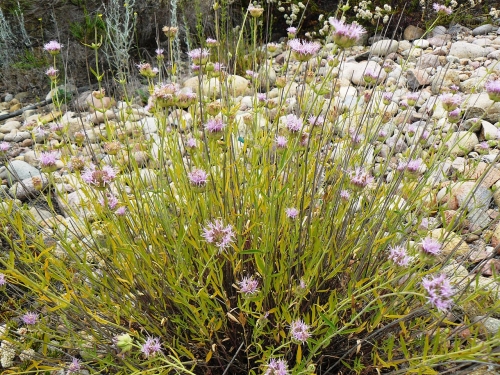
Willowy Monardella (Monardella viminea) is an extremely rare native perennial herb in the Lamiaceae (Mint) family that grows exclusively in San Diego County. Most of the world's willowy mint grows on the eastern side of the Miramar marine base or in nearby canyons. Its habitat consists of ephemeral streams: the bed, the edge, or the bench within a few feet of the bed. This species was formerly classified as a subspecies of Monardella linoides, and some sources still list it that way.
Despite its rarity and protected status, this plant is easy to grow in gardens and is often available from nurseries. It has a delightful mint fragrance. The pink to lavender flowers are attractive and does well in containers. Monthly irrigation keeps it evergreen and enables it to rebloom at any time of the year.
Perennial herb
10 - 19 in Tall
2 - 4 ft Wide
Summer Semi-deciduous
Pleasant

Pink, Lavender
Summer
Containers
Full Sun, Partial Shade
Low
Max 2x / month once established
Easy
Tolerates cold to 25° F
Fast
This plant naturally grows in coarse rocky sand or sandy clay, but it adapts to a wide range of soil conditions.
Soil PH: 6.5 - 7.8
Can be deadheaded if desired to encourage more flowering
For propagating by seed: No treatment.
In the wild, this plant is found in full sun in or within a few feet of creek beds in coastal sage scrub or chaparral habitats. Seedlings are more likely to start in the stream bed than at the edge or on the bench, but here they are also more likely to be eroded away. Their proximity to streams suggests that they need supplemental water to survive the summer and fall.
Chaparral, Coastal Sage Scrub
Willowy mint commonly grows side-by-side with California buckwheat (Eriogonum fasciculatum), California fuchsia (Epilobium canum), broom baccharis (Baccharis sarothroides), narrowleaf milkweed (Aslepias fascicularis), and poison oak (Toxicodendron diversilobum). Nearby chaparral shrubs include toyon (Heteromeles arbutifolia), mountain mahogany (Cercocarpus minutiflorus), hollyleaf cherry (Prunus ilicifolia), scrub oak (Quercus spp.), and California sagebrush (Artemisia californica).
Butterflies and moths supported
0 confirmed and 4 likely
Orange Tortrix Moth
Argyrotaenia franciscana
California Pyrausta Moth
Pyrausta californicalis
Shasta Pyrausta
Pyrausta perrubralis