

Carried by 72 nurseries
View Availability at NurseryData provided by the participants of the Consortium of California Herbaria
View additional distribution information on the Jepson eflora
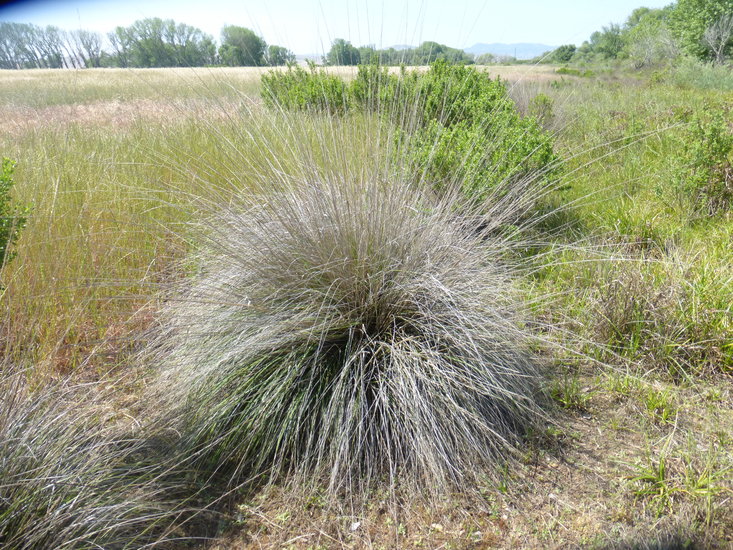
This native bunchgrass, Deergrass (Muhlenbergia rigens) is a popular plant choice for groundcover and lawn replacement applications. It's an attractive, low-water grass that's very easy to grow. Deergrass does best in sandy soil and full sun, but it is versatile enough to tolerate shade and a variety of soil types.
The leaf blades are pale green, and in spring the plant produces tall spikes of yellow flowers. The seeds provide food for birds in summer. Plant this large mounding grass in groups for an impressive display.
Grass
4 - 5 ft Tall
4 ft Wide
Upright, Fountain
Fast, Moderate
Evergreen
None

Yellow, Cream
Spring
Bank stabilization, Containers, Deer resistant, Groundcover, Lawn alternative
Full Sun
Low, Moderate
Max 1x / month once established
Easy
Fast, Medium, Slow
Tolerant of sand and clay.
Tolerates serpentine soil..
Soil PH: 5.0 - 8.0
Can be cut back in fall if it becomes unruly
For propagating by seed: No treatment.
1, 2, 3, 6*, 7*, 8*, 9*, 10*, 11*, 14*, 15*, 16*, 17*, 18*, 19*, 20*, 21*, 22*, 23*, 24*
In southern California and along the central coast it is found in sandy gravelly places, canyons, and washes as part of the chaparral community. In inland mountain areas it may occur with Ponderosa Pine and other trees in yellow pine woodland or foothill woodland. In a few locations it may be found on seasonal stream banks or other wetland areas.
Chaparral, Oak Woodland, Valley Grassland, Wetland-Riparian, Yellow Pine Forest
This is a large clumping grass, so use with shrubs that won't be overwhelmed by it, such as Toyon (Heteromeles arbutifolia), Lemonade Berry (Rhus integrifolia), larger Ceanothus, Manzanita species, or scrub oaks.
Butterflies and moths supported
0 confirmed and 1 likely
Green Cutworm Moth
Anicla infecta
Bornstein, C., Fross, D., & O'Brien, B. (2011). Reimagining the California Lawn.