

Carried by 7 nurseries
View Availability at NurseryData provided by the participants of the Consortium of California Herbaria
View additional distribution information on the Jepson eflora
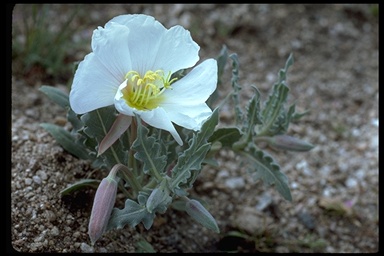
Oenothera californica is a species of flowering plant in the Onagraceae (Evening Primrose) family known by the common name California Primrose. It is native to parts of the southwestern United States and Baja California, where it can be found in chaparral, higher elevation deserts and woodlands. It is a perennial herb producing a spreading or upright stem up to 80 centimeters long. Young plants have a basal rosette of leaves, while older ones have leaves along the stem, lance-shaped to nearly oval in shape and up to 6 centimeters long. Flowers occur in the upper leaf axils, drooping in bud and becoming erect as they bloom. The four petals are white, fading pink, and may exceed 3 centimeters long. There are three subspecies of this plant, one of which, the rare Eureka Dunes evening primrose (ssp. eurekensis), is a federally listed endangered species. It is sometimes listed as its synonym, Oenothera avita ssp. eurekensis. This subspecies is known from only a few occurrences in the Eureka Valley Sand Dunes in Inyo County, where it grows alongside another dune endemic, the endangered Eureka Valley dune grass (Swallenia alexandrae). The other two subspecies are common.
Perennial herb
4 - 31 in Tall
10 ft Wide
Spreading
Summer Semi-deciduous
Pleasant

White, Pink
Spring
Lawn alternative
Full Sun, Partial Shade
Low, Very Low
Max 1x / month once established
Easy
Tolerates cold to 15° F
Fast
Prefers sandy, gravelly soil.
Soil PH: 5.0 - 8.0
Sandy or gravelly places, dunes, desert washes to 7, 500 ft.
Chaparral, Coastal Sage Scrub, Joshua Tree Woodland, Southern Oak Woodland
Use with Agave deserti or utahensis, Bigberry Manzanita (Arctostaphylos glauca), Big Sagebrush (Artemisia tridentata), Desert Marigold (Baileya multiradiata or pleniradiata), Desert Ceanothus (Ceanothus greggii), Goldenbush (Ericameria spp.), Buckwheat (Eriogonum spp.), Apache Plume (Fallugia paradoxa), Yucca (Hesperoyucca whipplei or Yucca schidigera or Y. baccata), Joshua Tree (Yucca brevifolia), Beargrass (Nolina parryi), Beardtongue (Penstemon spp.), Sage (Salvia Dorrii or mohavensis), Apricot Mallow (Sphaeralcea ambigua)
Butterflies and moths supported
0 confirmed and 13 likely
Fireweed Clearwing
Albuna pyramidalis
Ridings' Forester Moth
Alypia ridingsii
Orange Tortrix Moth
Argyrotaenia franciscana