

Carried by 9 nurseries
View Availability at NurseryData provided by the participants of the Consortium of California Herbaria
View additional distribution information on the Jepson eflora
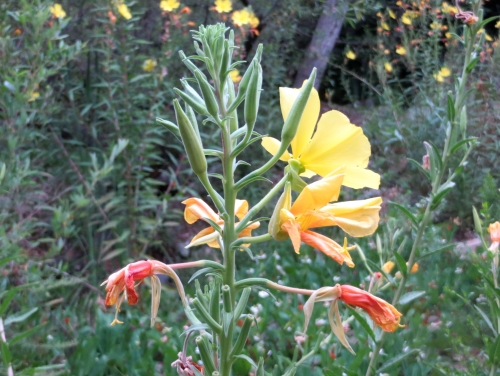
Hooker's Evening Primrose (Oenothera elata ssp. hookeri) is a native perennial herb in the Onagraceae (Evening Primrose) family that grows primarily along the coast between San Francisco and San Diego and northern Baja. It is fast growing and moderately long-lived. It grows in an upright form to a height of 5 feet, with active growth during the summer. Flowers are yellow and striking, and bloom in the late summer. Leaves are medium green and deciduous. Its form may be either upright or sprawling. It tends to grow in moist places, at elevations from sea level to 7,000 feet where it is a pioneer species. However, it is also somewhat drought-tolerant in garden situations. In the wild it is usually crowded out over time by more woody trees or shrubs. It spreads by prolific seed production, which also makes it attractive to many seed-eating birds.
Perennial herb
5 ft Tall
5 ft Wide
Upright, Spreading
Fast
Winter Deciduous
None

Yellow
Summer, Fall
Partial Shade, Full Sun
Low
Max 1x / month once established
Easy
Tolerates cold to 35° F
Fast, Medium, Slow
Adaptable to a variety of soil types, but does best in moist areas.
Soil PH: 4 - 7
Propagate plans from untreated seeds and sow seeds in the fall. Since this species is a biennial, so be sure to plant the seeds two successive years to establish a continuously flowering population. This primrose will vigorously reseed until proper conditions.
5, 6, 7, 14*, 15*, 16*, 17*, 18*, 19*, 20*, 21*, 22*, 23*, 24*
Moist places, disturbed areas, coastal areas.
Chaparral, Coastal Sage Scrub, Coastal Strand, Foothill Woodland, Lodgepole Forest, Mixed Evergreen Forest, Northern Coastal Scrub, Red Fir Forest, Forest, Sagebrush Scrub, Southern Oak Woodland, Yellow Pine Forest, Wetland-Riparian
Hooker's primrose can reseed vigorously, so be aware when planting it nearby other flowering plants. Taller plants, however, can out-compete. Consider using White Brodeiaea (Triteleia hyacinthina) or the Pitkin Marsh Lily (Lilium pardalinum ssp. pitkinense).
Butterflies and moths supported
0 confirmed and 15 likely
Fireweed Clearwing
Albuna pyramidalis
Langston's Forester
Alypia langtoni
Ridings' Forester Moth
Alypia ridingsii