

Carried by 40 nurseries
View Availability at NurseryData provided by the participants of the Consortium of California Herbaria
View additional distribution information on the Jepson eflora
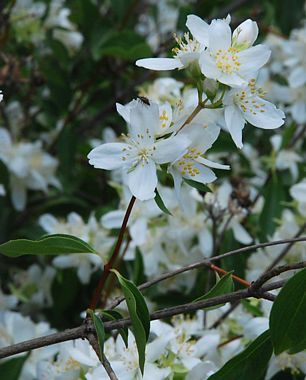
Mock orange (Philadephus lewisii) is a deciduous shrub covered in a mass of white blossoms at the height of flowering, in spring to summer. Mock orange is widespread but not common, usually appearing as an individual plant in a mix of other species.
The shrub sends out long stems, which are red when new and fade to gray with age. Its leaves are light green in color with a rough texture, generally turning a lovely yellow in fall. The large flowers bloom in clusters at the ends of long stems and have a heavy, sweet scent similar to citrus blossom. They are among the most fragrant flowers of any California native plant. It is fast-growing and tolerates almost any soil type, making it a wonderful focal plant in a garden.
Shrub
5 - 12 ft Tall
6 ft Wide
Upright, Rounded
Moderate
Winter Deciduous
Pleasant

Yellow, White
Summer, Spring
Hedge
Full Sun, Partial Shade
Moderate
Max 3x / month once established
Easy
Tolerates cold to -10° F
Medium
Well-drained soils that are coarse to medium (rich, loamy) textured.
Soil PH: 5.0 - 8.0
Flowers on last year's wood, so prune non-productive or dead wood directly after end of bloom period. Can coppice if plant is quite woody with sparse foliage. This method can significantly improve the appearance of this shrub, but be careful not to cut the roots!
Seed, cuttings or root sections. For propagating by seed: 2 to 3 months stratification.
1, 2, 3, 4*, 5*, 6*, 7*, 8*, 9*, 10, 14*, 15*, 16*, 17*, 18*, 19*, 20*, 21*, 22*, 23*, 24*
Rocky slopes, canyons, open areas primarily of mountainous regions between 1000 and 4000 ft as a component of foothill woodland or evergreen forest
Foothill Woodland, Mixed Evergreen Forest, Yellow Pine Forest
Western Serviceberry (Amelanchier utahensis), Manzanita (Arctostaphylos spp.), Spicebush (Calycanthus occidentalis), Ceanothus spp., Western Redbud (Cercis occidentalis), California Coffeeberry (Frangula californica), Oaks (Quercus spp.), and Gooseberry and Currant (Ribes spp.)
Butterflies and moths supported
0 confirmed and 2 likely
Johnson's Euchlaena
Euchlaena johnsonaria