

Carried by 2 nurseries
View Availability at NurseryData provided by the participants of the Consortium of California Herbaria
View additional distribution information on the Jepson eflora
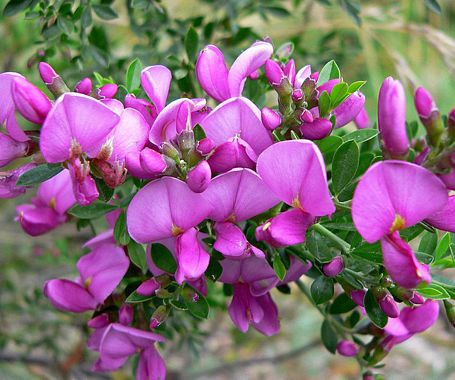
Pickeringia is a monotypic genus containing only the legume Pickeringia montana, which is known by the common name chaparral pea. It is sometimes called Montana chaparral pea, but this plant is found only in California. It is one of very few legumes native to the chaparral habitat. Its nitrogen-fixing ability helps it thrive in rocky, sandy soil. The plant is also well-suited to a landscape of hills, slopes, and recently-burned areas; its roots spread quickly and help anchor loose soil, preventing erosion. The chaparral pea is said to rarely sprout from seed because the plant rarely produces seed pods. More often it sends up new stems from roots growing outward from the mother plant. It forms low, dense, thorny thickets of shiny dark green leaves. In spring and summer the plant bursts into blossom, covering the thickets with bright magenta flowers.
Shrub
1 - 6 ft Tall
8 ft Wide
Mounding
Summer Semi-deciduous

Lavender, Pink, Purple, Red
Spring, Summer
Containers, Deer resistant
Full Sun, Partial Shade
Very Low
Never irrigate once established
Tolerates cold to 25° F
Fast
Typically found in the wild in rocky, gravelly or sandy soil. May be tolerant of garden soil if drainage is very good.
Soil PH: 6.0 - 8.0
This is the hardest part with this plant. If you can obtain seeds, they reportedly germinate well. Otherwise, root cuttings can be tried. Growth may be slow at first until the cutting establishes more roots to support above ground growth. For propagating by seed: Hot water and 1 mo. stratification.
Dry, rocky slopes of the Coast Ranges and foothills of the Sierras, usually below 5, 000 ft.
Chaparral, Mixed Evergreen Forest
Manzanita (Arctostaphylos spp.), Ceanothus species, Bush Poppy (Dendromecon rigida), Yerba Santa (Eriodictyon spp.), and Woolly Bluecurls (Trichostema lanatum)