

Carried by 1 nurseries
View Availability at NurseryData provided by the participants of the Consortium of California Herbaria
View additional distribution information on the Jepson eflora
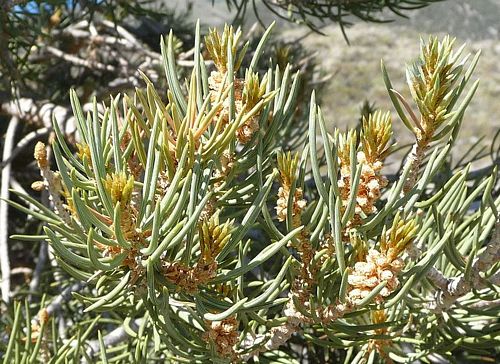
The Single-leaf Pinyon (Pinus monophylla) is a pine in the pinyon pine group, native to the United States and northwest Baja, Mexico. Within California it is found in the Sierras, the Transverse Range, and Peninsular Range. It occurs at moderate altitudes from 1200-2300 meter, rarely as low as 950 meter and as high as 2900 meter, in the most arid areas occupied by any pine in California. It is widespread and often abundant in this region, forming extensive open woodlands, often mixed with junipers. It is a small to medium size tree, reaching 10-20 meter tall and with a trunk diameter of up to 80 centimeter, rarely more. However, it is very slow growing, reaching only 3 ft. in seven years.The bark is irregularly furrowed and scaly. It is the world's only 1-needled pine; the leaves ('needles') are usually single (though trees with needles in pairs are found occasionally), stout, 4-6 centimeter long, and grey-green to strongly waxy pale blue-green, with stomata over the whole needle surface (and on both inner and outer surfaces of paired needles). The cones are acute-globose, the largest of the true pinyons, 4.5-8 centimeter long and broad when closed, green at first, ripening yellow-buff when 18-20 months old, with only a small number of very thick scales, typically 8-20 fertile scales. The cones open to 6-9 centimeter broad when mature, holding the seeds on the scales after opening. The seeds are 11-16 millimeter long, with a thin shell, a white endosperm, and a vestigial 1-2 millimeter wing; they are dispersed by the Pinyon Jay, which plucks the seeds out of the open cones. The jay, which uses the seeds as a food resource, stores many of the seeds for later use by burying them. Some of these stored seeds are not used and are able to grow into new trees. Indeed, Pinyon seeds will rarely germinate in the wild unless they are cached by jays or other animals. The seeds (pine nuts) are also harvested and eaten by people.
Tree
20 - 66 ft Tall
35 ft Wide
Rounded
Very Slow, Slow
Evergreen
Pleasant

Yellow
Spring
Bank stabilization, Hedge
Full Sun, Partial Shade
Low, Very Low
Max 1x / month once established
Moderate
Tolerates cold to -15° F
Fast, Medium, Slow
Found in decomposed granite, sandstone and loamy clay.
Soil PH: 6.0 - 8.0
For propagating by seed: 1-3 mos. stratification (USDA Forest Service 1974). No treatment. necessary if maximum germinating temperature is below 73°F ( Heit 1968a).
1, 2*, 3*, 4, 5, 6, 7*, 8, 9, 10, 11, 12, 14*, 15*, 16*, 17, 18*, 19*, 20*, 21*, 22*, 23*, 24
Rocky slopes
Foothill Woodland, Pinyon-Juniper Woodland
In the wild it occurs with Sagebrush (Artemisia spp.), Buckbrush (Ceanothus cuneatus), Desert Ceanothus (C. greggii), Desert Mountain Mahogany (Cercocarpus ledifolius), Buckwheat (Eriogonum spp.), Apache Plume (Fallugia paradoxa), Flannelbush (Fremontodendron californicum), Yucca (Hesperoyucca spp. or Yucca spp.), California Juniper (Juniperus californica), Antelope Brush (Purshia tridentata), Desert Sage (Salvia dorrii), Rose Sage (Salvia pachyphylla), and various cactus species
Butterflies and moths supported
0 confirmed and 88 likely
Common Gray
Anavitrinella pampinaria
Polyphemus moth
Antheraea polyphemus
Orange Tortrix Moth
Argyrotaenia franciscana
Western Pine Elfin
Callophrys eryphon