

Carried by 0 nurseries
View Availability at NurseryData provided by the participants of the Consortium of California Herbaria
View additional distribution information on the Jepson eflora
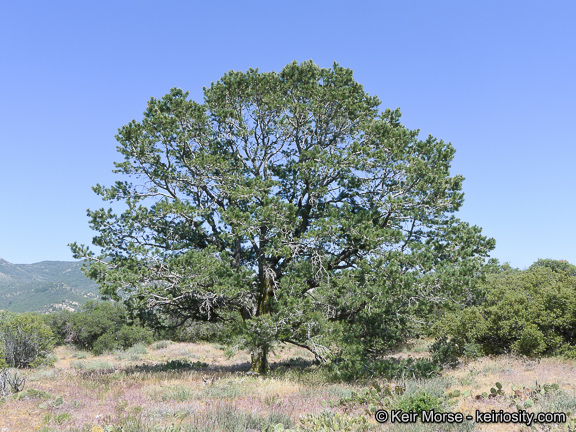
Pinus quadrifolia, the Parry pinyon, is a pine in the pinyon pine group native to southernmost California in the United States and northern Baja California in Mexico, from 33 degrees 30' N south to 30 degrees 30' N. It occurs at moderate altitudes from 1,300 metres (4,300 ft) to 1,800 metres (5,900 ft), rarely as low as 1,200 metres (3,900 ft) and as high as 2,500 metres (8,200 ft). It is scarce and often scattered in this region, forming open woodlands, usually mixed with junipers. Other common names include nut pine and fourleaf pinyon pine. Pinus quadrifolia is a small to medium size tree, reaching 8 metres (26 ft) to 15 metres (49 ft) tall and with a trunk diameter of up to 40 centimetres (16 in), rarely more. The bark is thick, rough and scaly. The leaves ('needles') are in fascicles of 4-5, moderately stout, 2. 5 centimetres (0. 98 in)-5. 5 centimetres (2. 2 in) long; glossy dark green with no stomata on the outer face, and a dense bright white band of stomata on the inner surfaces. The cones are globose, 4 centimetres (1. 6 in)-5. 5 centimetres (2. 2 in) long and broad when closed, green at first, ripening yellow to orange-buff when 18-20 months old, with only a small number of thick scales, with typically 5-10 fertile scales. The cones open to 5 centimetres (2. 0 in) to 7 centimetres (2. 8 in) broad when mature, holding the seeds on the scales after opening. The seeds are 10 millimetres (0. 39 in)-14 millimetres (0. 55 in) long, with a thin shell, a white endosperm, and a vestigial 1 millimetre (0. 039 in)-2 millimetres (0. 079 in) wing; they are dispersed by the pinyon jay, which plucks the seeds out of the open cones. The jay, which uses the seeds as a food resource, stores many of the seeds for later use, and some of these stored seeds are not used and are able to grow into new trees.
Tree
26 ft Tall
Pyramidal, Rounded
Slow
Evergreen
Pleasant
Hedge
Full Sun, Partial Shade
Moderate
Fresh seed required, benefits from stratification (2 - 3 months)
Pinyon-Juniper Woodland
Many companion plants including: Pinus jefferyi, Coulter Pine (Pinus coulteri), Scrub Oak (Quercus berberidifolia), Quercus wislezeni, Torrey's Hybrid Oak (Quercus acutidens), Desert Oak (Quercus palmeri), Arctostphylos pringlei, Flannel Bush (Fremontodendron californicum), Garrya flavescens, Garrya veatchii, Red Shanks (Adenostoma sparsifolium), Chamise (Adenostoma fasciculatum), Mountain Mahogany (Cercocarpus betuloides), San Diego Mountain Mahogany (Cercocarpus minutiflorus), Mojave Yucca (Yucca schidigera), Hersperoyucca whipplei, Parry's Nolina (Nolina parryi), Opuntia spp., Cup-leaved Ceanothus (Ceanothus perplexans), Parish's Bluecurls (Trichostema parishii), California Buckwheat (Eriogonum fasciculatum)
Butterflies and moths supported
0 confirmed and 32 likely
Common Gray
Anavitrinella pampinaria
Polyphemus moth
Antheraea polyphemus
Western Pine Elfin
Callophrys eryphon
Red Girdle Moth
Caripeta aequaliaria