

Carried by 7 nurseries
View Availability at NurseryData provided by the participants of the Consortium of California Herbaria
View additional distribution information on the Jepson eflora
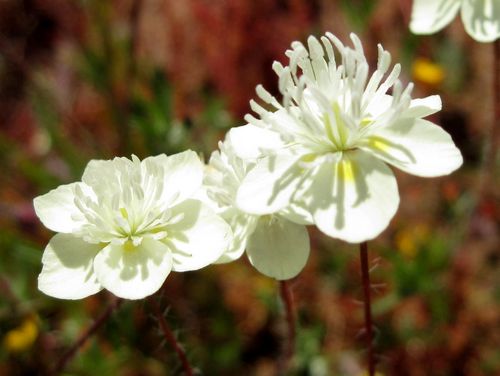
Platystemon is a monotypic genus of flowering plants in the Papaveraceae (Poppy) family containing the single species Platystemon californicus, which is known by the common name Creamcups. It is native to the southwestern United States and Baja California, where it is a common spring wildflower in many types of habitat. In California it is found from north to south, along the coast, in foothills, the Coast Ranges, Transverse Range and Peninsular Range. It is populr as an ornamental plant for landscaping and revegetation of recently burned areas. This is an annual herb which is quite variable in appearance. The oppositely arranged leaves are 2 to 8 centimeters long and in shape linear, lance-shaped, or oblong. It is hairy in texture, sometimes with very long hairs. The flower cluster is a single flower on a tall peduncle up to 20 centimeters high. The flower has six petals which may be pure white or golden or white with large gold spots or gold tips. The center of the flower is filled with a tuftlike cluster of many thick, flattened stamens. The fruit is a capsule with several one-seeded sections that break apart. There is one recognized variety, var. ciliatus, which is a rare plant endemic to Santa Barbara Island.
Annual herb
8 - 12 in Tall
6 in Wide

Cream, White, Yellow
Winter, Spring
Full Sun
Low
Max 2x / month once established
Tolerates cold to 10° F
Fast
Prefers sandy, gravelly soil. No clay.
Soil PH: 5.8 - 8.2
By seed
6, 7*, 8*, 9*, 10, 11, 12, 14*, 15*, 16*, 17*, 18*, 19*, 20*, 21*, 22*, 23*, 24*
Open grassy places, sandy soils, recently burned areas
Chaparral, Coastal Sage Scrub, Foothill Woodland, Northern Oak Woodland, Southern Oak Woodland, Valley Grassland
Use in a wildflower meadow garden with other annuals or herbaceous perennials such as Clarkia spp., California Poppy (Eschscholzia californica), Baby Blue Eyes (Nemophila menziesii), with geophytes such as wild onion (Allium spp.), Mariposa Lily (Calochortus spp.), and Blue Dicks (Dichelostemma capitatum), and with native grasses