

Carried by 2 nurseries
View Availability at NurseryData provided by the participants of the Consortium of California Herbaria
View additional distribution information on the Jepson eflora
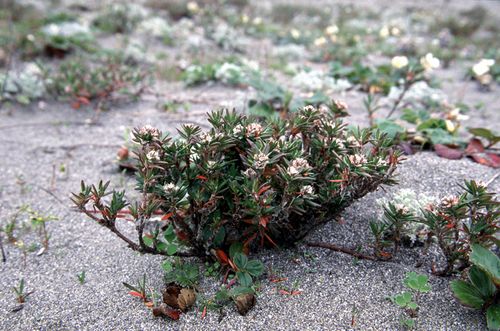
Polygonum paronychia is a species of flowering plant in the knotweed family known by the common names dune knotweed, black knotweed, and beach knotweed. It is native to the coastline of western North America from British Columbia to California, where it grows in sandy coastal habitat such as beaches, dunes, and scrub. Polygonum paronychia is a small prostrate or upright shrub producing multibranched brown stems up to a meter (40 inches) long. The stems may root at nodes that come in contact with moist substrate. The leaves are alternately arranged on the stems but are mostly located bunched around the tips of the stem branches. The leaves are linear to lance-shaped with rolled edges and bristly midribs on the undersides. Each leaf has a large stipule which forms a wide, membranous ochrea. The ochrea is up to 2 centimeters (0. 8 inches) long and is persistent, fraying into fibrous, silvery shreds that remain on the plant through the seasons. Flowers occur in the leaf axils. Each is up to a centimeter (0. 4 inches) wide with five narrow white or pinkish corolla lobes. Polygonum paronychia is a small prostrate or upright shrub producing multibranched brown stems up to a meter (40 inches) long. The stems may root at nodes that come in contact with moist substrate. The leaves are alternately arranged on the stems but are mostly located bunched around the tips of the stem branches. The leaves are linear to lance-shaped with rolled edges and bristly midribs on the undersides. Each leaf has a large stipule which forms a wide, membranous ochrea. The ochrea is up to 2 centimeters (0. 8 inches) long and is persistent, fraying into fibrous, silvery shreds that remain on the plant through the seasons. Flowers occur in the leaf axils. Each is up to a centimeter (0. 4 inches) wide with five narrow white or pinkish corolla lobes.
Perennial herb
4 - 40 in Tall

White, Red
Spring, Summer, Fall
Groundcover, Deer resistant
Full Sun, Partial Shade, Deep Shade
Extremely Low, Very Low
Fast
For propagating by seed: No treatment.
4, 5, 14, 15, 16*, 17*, 19, 20, 21, 22*, 23*, 24*
Dunes
Coastal Strand
Butterflies and moths supported
1 confirmed and 15 likely
Buckwheat Borer Moth
Synanthedon polygoni
Civil Rustic
Caradrina montana
Guenée's Carpet Moth
Ceratodalia gueneata
Morning-glory Plume Moth
Emmelina monodactyla