

Carried by 19 nurseries
View Availability at NurseryData provided by the participants of the Consortium of California Herbaria
View additional distribution information on the Jepson eflora
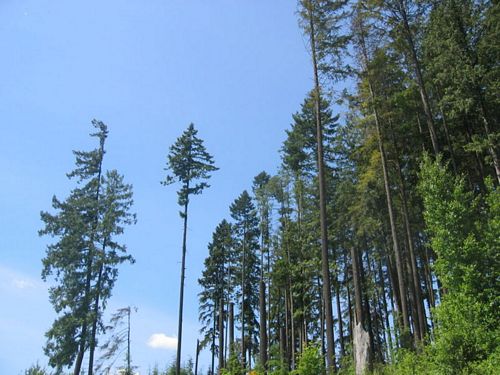
Douglas Fir or Douglas-fir, Pseudotsuga menziesii, is an evergreen conifer native to the coastal regions of western North America, from central California north through Oregon and Washington to British Columbia, Canada. In California, it is found in the Klamath Mountains and the Cascade Range, the California Coast Ranges as far south as the Santa Lucia Mountains in Monterey County, and the Sierra Nevada as far south as the Huntington Lake region in Fresno County.
In California the Douglas Fir and its variety named Coast Douglas Fir (Pseudotsuga menziesii var. menziesii) occur from near sea level along the coast to 5,900 feet (1800 m) in the Sierra Nevada. Eastward they are replaced by its variety named Rocky Mountain Douglas Fir (Pseudotsuga menziesii var. glauca). Its variety named Mexican Douglas Fir (Pseudotsuga menziesii var. lindleyana) is endemic to central and northern montane Mexico.
Douglas Firs commonly live more than 500 years and occasionally more than 1,000 years. The species name, menziesii, honors Archibald Menzies, the first European botanist to document it (1791). The common name honors botanist David Douglas, who introduced it into cultivation (1827). Douglas Firs are commercially important for lumber.
Due to their robust mature size Douglas Fir trees are not frequently planted in small to mid-size residential gardens. Since they can get exceptionally large they need to be provided with plenty of space to grow above and below ground.
Douglas Firs are the second-tallest conifer species in the world after Coast Redwoods (Sequoia sempervirens). Trees 200-250 feet (60-75 meters) in height and trunks 5-6.6 feet (1.5-2 m) in diameter are common in old growth forests. Maximum heights of 330-390 feet (100-120 m) and trunk diameters of 15-20 feet (4.5-6 m) were historically documented. The "Doerner Fir" in Oregon is the tallest known currently living Douglas Fir at 326 ft. (99.4 m) tall; and the "Queets Fir" in Olympic National Park has the widest known currently living trunk at 16 ft. (4.85 m) in diameter.
Tree
40 - 250 ft Tall
Pyramidal, Upright
Moderate
Evergreen
Spring
Bank stabilization, Deer resistant
Partial Shade, Full Sun
Low, Moderate
Max 1x / week once established
Easy
Tolerates cold to 5° F
Medium
Prefers rich, forest soil with well-decomposed organic component derived from decaying wood. For garden purposes add redwood compost to soil mix.
Soil PH: 4.0 - 6.0
Prune in winter when wood boring insects are less active.
For propagating by seed: 3-6 wks. stratification. No treatment may give satisfactory germination (USDA Forest Service 1974). Extended stratification lowers optimal germination termparture and germination may occur in refrigerator.
Forests of California, the Pacific Northwest, & British Colombia
Douglas-Fir Forest, Mixed Evergreen Forest, North Coastal Coniferous Forest, Forest, Yellow Pine Forest
Use with compatible forest plants such as Big Leaf Maple (Acer macrophyllum), Vine Maple (Acer circinatum), Rocky Mountain Maple (Acer glabrum), Manzanitas (Arctostaphylos canescens, Arctostaphylos nevadensis), Oregon Grapes (Berberis aquifolium, Berberis pinnata), Coast Barberry (Berberis nervosa), and Ocean Spray (Holodiscus discolor)
Butterflies and moths supported
67 confirmed and 22 likely
Common Gray
Anavitrinella pampinaria
Fruit-Tree Leafroller Moth
Archips argyrospila