

Carried by 11 nurseries
View Availability at NurseryData provided by the participants of the Consortium of California Herbaria
View additional distribution information on the Jepson eflora
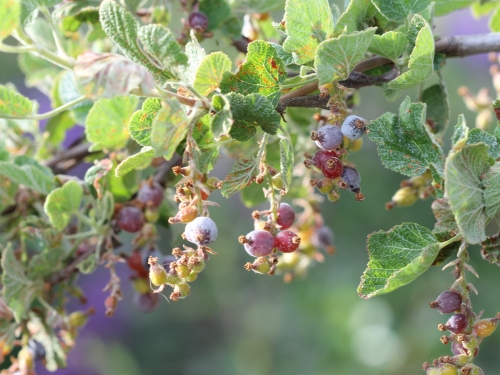
Ribes indecorum is a species of currant known by the common names white-flowered currant and white chaparral currant. It is native to the southern California Coast Ranges, Transverse Ranges, and Peninsular Ranges, from around Santa Barbara County in California south into northern Baja California.
It is an erect shrub approaching three meters in maximum height. The stem is fuzzy and glandular in texture. The deciduous leaves are 1 to 4 centimeters long. The thick, wrinkly blades are divided into three to five toothed lobes, and are hairy, glandular, and aromatic. The inflorescence is a loose raceme of 10 to 25 flowers. The flower is roughly tubular with the white or pink-tinged sepals spreading open to reveal smaller whitish petals inside. Flowers bloom in late winter / early spring, and have an exceptionally pleasant fragrance, among the best of any California native.The fruit is a hairy, sticky very attractive berry that can be orange, purple, pink or red, and are under a centimeter wide.
White Flowering Currant is very drought tolerant once established, but still does does best in part shade, or in spots that retain slightly more moisture, such as creek sides, north or east facing slopes, or adjacent to boulders. Best to avoid direct summer water after this plant is established. It'll go nearly completely summer deciduous, and then spring back to life with the start of the rainy season.
Shrub
5 - 10 ft Tall
1 - 2 ft Wide
Upright Columnar
Moderate
Summer Deciduous, Summer Semi-deciduous, Winter Deciduous
Pleasant

White, Pink
Winter
Deer resistant
Partial Shade, Full Sun
Low, Very Low
Max 1x / month once established
Moderate
Tolerates cold to -15° F
Medium, Slow
Rich, loamy soil.
Soil PH: 6 - 8
7, 8, 9, 11, 14*, 15*, 16*, 17*, 18*, 19*, 20*, 21*, 22*, 23*, 24*
Dry slopes, often near boulders or creeks, shady slopes or in gullies. Often grows under oak trees, and sometimes under sycamores.
Chaparral
Spiny Redberry (Rhamnus crocea), Mission Manzanita (Xylococcus bicolor), Laurel Sumac (Malosma laurina), Coast Live Oak (Quercus agrifolia var. agrifolia), Sugar Bush (Rhus ovata)
Butterflies and moths supported
0 confirmed and 72 likely
Milbert's Tortoiseshell
Aglais milberti
Western Avocado Leafroller Moth
Amorbia cuneana