

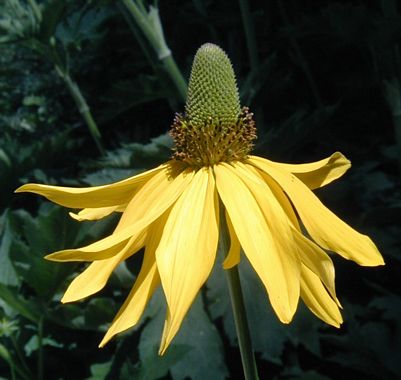
Carried by 5 nurseries
View Availability at NurseryData provided by the participants of the Consortium of California Herbaria
View additional distribution information on the Jepson eflora
California Coneflower, with the botanical name Rudbeckia californica, is a deciduous perennial species in the Sunflower or Aster Family (Asteraceae). It is a large showy flowering plant, that grows in seeps, meadows and wetlands, at elevations of 400-7,800 feet, in Red Fir Forest and Mountain Meadow habitats from the central Sierra Nevada and in the Klamath Mountains into into southwestern Oregon
The Klamath Coneflower, a former variety of this species named Rudbeckia californica var. intermedia and endemic to northwestern California in the Klamath Mountains, has been reclassified as the species Rudbeckia klamathensis.
California Coneflower grows from a thick rhizome, reaching 3 to 6 feet (1-2 m) tall. It has large leaves that can be up to 1 foot (30 cm) long, and are lance-shaped to oval, smooth-edged or lobed. Most of these large leaves are basal, with a few alternately arranged along the bloom stems.
The yellow flower has an inflorescence that is a usually solitary sunflower-like flower head with a base up to 2.5 inches (6 cm) wide lined with several ray florets, each of which are 0.75 to 2.5 inches (2-6 cm) long. The yellow ray florets extend outwards and then become reflexed, pointing back down along the stem. It blooms in July and August. The disc florets filling the button-shaped to conical to cylindrical center of the head are greenish yellow. The fruits are achenes tipped with a pappus of scales.
California Coneflower prefers partially shaded, cool, and seasonally to always moist garden conditions.
Perennial herb
6 ft Tall
1 ft Wide
Upright
Winter Deciduous
Pleasant

Green, Yellow
Summer
Partial Shade
Low, Moderate, High
Easy
Fast
Prefers moist, but can tolerate seasonally dry.
Soil PH: 6 - 7.5
Cut back after first killing frost. Remove dead heads.
Propagate by seed or by cuttings in the spring.
1, 2, 3, 4, 5, 6*, 7, 8, 9, 10, 14*, 15*, 16*, 17*, 18*, 19
Meadows and seeps
Douglas-Fir Forest, North Coastal Coniferous Forest, Red Fir Forest, Yellow Pine Forest, Wetland-Riparian
Other wet loving plants such as Lilium pardalinum, Western Azalea (Rhododendron occidentale), Green Alder (Alnus viridis)
Butterflies and moths supported
0 confirmed and 2 likely
Common Eupithacia
Eupithecia miserulata
Wavy-Lined Emerald
Synchlora aerata