

Carried by 0 nurseries
View Availability at NurseryData provided by the participants of the Consortium of California Herbaria
View additional distribution information on the Jepson eflora
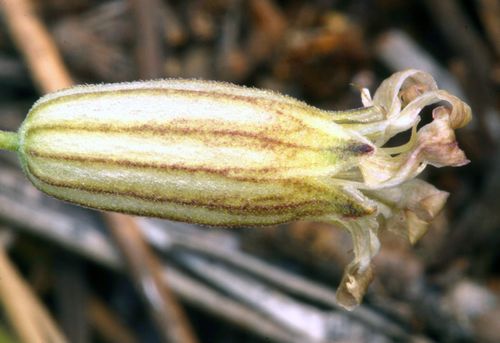
Silene douglasii is a species of flowering plant in the pink family known by the common name Douglas's catchfly. It is native to western North America from British Columbia to California to Wyoming, where it grows in several habitat types, including forests, woodlands, and coastal scrub. Silene douglasii is a tufted perennial herb growing from a branching caudex and taproot, its stems decumbent to erect and up to 70 centimeters long. The stem is coated in curly or feltlike gray-white hairs. The lance-shaped leaves are up to 6 centimeters long on the lower stem and are smaller farther up. Each flower is encapsulated in a cylindrical inflated calyx of sepals lined with ten green or purple-red veins. It is open at the tip, revealing five white, pink or purplish petals, each with two wide lobes at the tip. Varieties: There are three varieties of this species. Silene douglasii var. douglasii Silene douglasii var. oraria - Seabluff catchfly, rare and endemic to the Oregon coastline. Silene douglasii var. rupinae
Annual herb, Perennial herb
2 ft Tall

White, Pink, Purple, Red
Full Sun, Partial Shade
Low, Moderate
Open places
Lodgepole Forest, Red Fir Forest, Sagebrush Scrub, Yellow Pine Forest
Butterflies and moths supported
0 confirmed and 1 likely
Rufous Quaker Moth
Protorthodes rufula