

Carried by 58 nurseries
View Availability at NurseryData provided by the participants of the Consortium of California Herbaria
View additional distribution information on the Jepson eflora
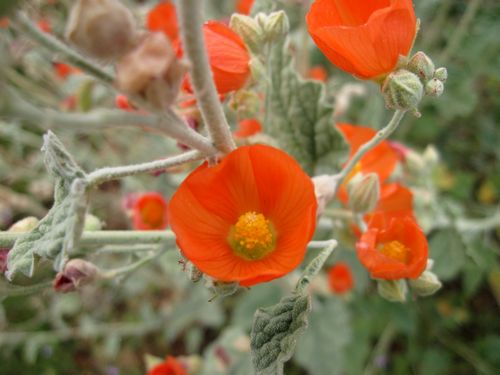
Desert globemallow (Sphaeralcea ambigua), also known as apricot mallow, is a perennial shrub with fuzzy, whitish-green leaves and bowl-shaped orange flowers that put on a stunning display in full bloom. A member of the mallow family (Malvaceae), it thrives in creosote bush scrub and desert chaparral habitats across parts of California, Nevada, Utah, Arizona, Sonora, and Baja California.
This drought-adapted plant grows well in both sandy and clay alkaline soils. It can be cut back in the fall to maintain a compact shape. There are three varieties, including Sphaeralcea ambigua var. rosacea, which features lavender-colored flowers.
Desert globemallow is an excellent butterfly plant and a great addition to desert landscapes.
Perennial herb
3 - 5 ft Tall
2 - 4 ft Wide
Upright, Rounded
Fast
Evergreen

Red, Orange, Pink, Lavender
Spring, Winter
Containers
Full Sun
Very Low, Low
Max 1x / month once established
Easy
Tolerates cold to 15° F
Fast
Adaptable, but prefers fast-draining desert soil.
Tolerates sodic soil..
Soil PH: 6.0 - 8.0
A good pruning after blooming will help to keep it from getting too woody
For propagating by seed: No treatment. Germination may be poor.
Desert and semi-desert areas, often with boulders
Creosote Bush Scrub, Desert-Holly Scrub, Joshua Tree Woodland, Pine-Juniper Woodland
Trees - Palo Verde (Parkinsonia spp.), Ironwood (Olneya tesota), Pinyon Pine (Pinus monophylla), Smoketree (Psorothamnus spinosus), California Fan Palm (Washingtonia filifera), Joshua Tree (Yucca brevifolia), California Juniper (Juniperus californicus)
Other plants - Desert Holly (Atriplex hymenelytra), Creosote Bush (Larrea tridentata), Desert Lavender (Condea emoryi), Desert Agave (Agave deserti), Ocotillo (Fouquieria splendens), Brittlebush (Encelia farinosa), Desert Scrub Oak (Quercus cornelius-mulleri), Yucca species, various cactus species
Butterflies and moths supported
7 confirmed and 6 likely
Northern White-Skipper
Heliopetes ericetorum
Common Checkered-Skipper
Pyrgus communis
Small Checkered-Skipper
Pyrgus scriptura