

Carried by 32 nurseries
View Availability at NurseryData provided by the participants of the Consortium of California Herbaria
View additional distribution information on the Jepson eflora
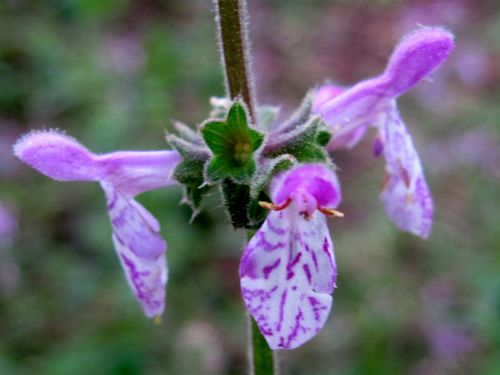
California Hedgenettle (Stachys bullata) is a perennial evergreen herb in the Mint family. California Hedgenettle is a delicate, attractive flowering plant that performs well in damp, partially shaded areas. It tends to grow in wet, swampy, boggy places, at elevations from sea level to 1,600 feet. The leaves are deep green and tongue-shaped. Two-lipped purple or pink flowers bloom on stalks spring through summer.
Throughout the rest of the year, the plant forms a bushy, spreading groundcover. Like most wetland plants, it spreads to occupy suitably damp land but is easily controlled. California Hedgenettle thrives in partially shaded areas and will tolerate clay soils. While not drought adapted, this plant is a good choice for bioswales, pond margins, and similar areas where a showy, flowering plant may be desired.
California Hedgenettle attracts hummingbirds, butterflies and other insects. Despite its common name, it does not form a hedge nor sting like true nettles.
Perennial herb
1 - 3 ft Tall
Moderate
Evergreen
Slight

Lavender
Spring, Summer, Fall
Deer resistant
Deep Shade, Partial Shade
Moderate, High
Max 1x / week once established
Moderate
Tolerates cold to 15° F
Slow, Standing
Tolerates a variety of soils as long as adequate water is present.
Soil PH: 5.5 - 7.5
For propagating by seed: No treatment.
5, 7, 8*, 9*, 14*, 15*, 16*, 17*, 18, 19*, 20*, 21*, 22*, 23*, 24*
Wet areas such as streambanks, pond margins, springs, bogs, seeps and drainage ditches
Chaparral, Coastal Sage Scrub, Mixed Evergreen Forest, Forest
Use with other plants of wet areas including Willow (Salix spp.), Cottonwood (Populus spp.), Sycamore (Plataunus racemosa), Sedge (Carex spp.), Rush (Juncus spp.), Monkeyflower (Mimulus cardinalis and guttatus), and Stream Orchid (Epipactis gigantea)
Butterflies and moths supported
1 confirmed and 10 likely
Geranium Plume Moth
Amblyptilia pica
Orange Tortrix Moth
Argyrotaenia franciscana