

Carried by 0 nurseries
View Availability at NurseryData provided by the participants of the Consortium of California Herbaria
View additional distribution information on the Jepson eflora
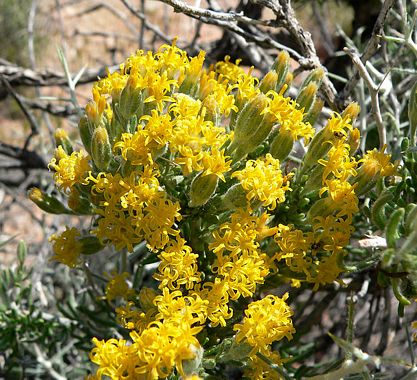
Tetradymia axillaris is a flowering plant in the Asteraceae (Sunflower) family known by the common names Cotton Catclaw and Longspine Horsebrush. This is a plant of the sagebrush and desert plant communities of the southwestern United States. In California it is found from Mono County southward to Riverside County. The plant forms a sprawling thicket and is very spiny. The spine is a modified central leaf vein; the green leaves dry and their tissues fall away, leaving the veins as hard, sharp spines. When in foliage the bush has green, hairy stems and bears yellow rayless flowerheads in the axils, or angles, of the newest branches. The fruits are released in masses of cottony seed. The sharp spines were used as tattooing needles by the Kawaiisu Native Americans. This plant should be used away from traffic where the spines will not be a problem. This is a very different plant from Catclaw Acacia (Senegalia greggii) which is a legume that grows in the desert further south.
Shrub
5 ft Tall
5 ft Wide
Summer Semi-deciduous

Yellow, Green
Spring
Full Sun, Partial Shade
Low
Max 1x / month once established
Tolerates cold to 0° F
Fast
Rocky, sandy or gravelly.
Soil PH: 6.0 - 8.0
Moist places in mountains or high desert
Joshua Tree Woodland, Pinyon-Juniper Woodland
Use with other high desert species such as Utah Agave (Agave utahensis), Bigberry Manzanita (Arctostaphylos glauca), Big Sagebrush (Artemisia tridentata), Fremont Barberry (Berberis fremontii), Desert Ceanothus (Ceanothus greggii), Desert Willow (Chilpsis linearis), Buckwheat (Eriogonum spp.), Apache Plume (Fallugia paradoxa), California Juniper (Juniperus californica), Bladderpod (Peritoma arborea), Antelope Brush (Purshia stansburyana or tridentata), Sage (Salvia dorrii or mohavensis), Jojoba (Simmondsia chinensis), Banana Yucca (Yucca baccata), and various cactus species.