

Carried by 44 nurseries
View Availability at NurseryData provided by the participants of the Consortium of California Herbaria
View additional distribution information on the Jepson eflora
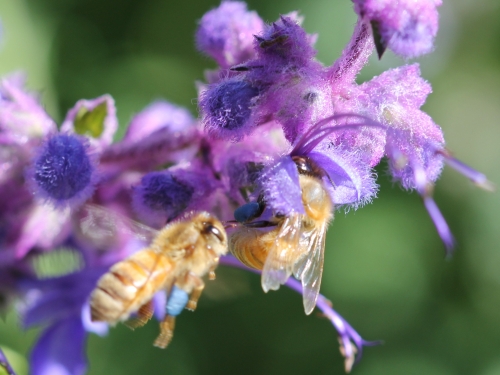
Woolly Bluecurls (Trichostema lanatum) is named for its curled, fuzzy flowers that bloom in brilliant shades of blue and lavender. These striking flowers bloom in dense clusters on branching stems from fall to spring. A favorite of hummingbirds, the flowers also attract bees, butterflies, and other insects.
This shrub is a member of the Mint family. Its narrow, bright green leaves have a pleasant, minty fragrance. It can quickly grow to an impressive size in the first year, although as a fire-following plant, it does have a short lifespan (around 4 to 5 years).
In the garden, this plant requires specific growing conditions to do well. A young Woolly Bluecurls plant needs regular watering after planting. Once it's established, however, overwatering - even occasional summer water - can damage or kill them. Plant in full or part sun in light, well-draining soil. It does well in rocky areas and does not like mulch. Although short-lived, the showy blooms make this plant a stunning addition to a low-water pollinator garden.
Plant type
Shrub
Size
5 ft Tall
10 ft Wide
Form
Fountain
Growth rate
Fast
Dormancy
Evergreen
Fragrance
Pleasant

Color
Blue, Lavender, Pink
Flowering season
Fall, Winter, Spring
Special uses
Containers, Deer resistant
Sun
Partial Shade, Full Sun
Water
Low, Very Low
Summer irrigation
Max 1x / month once established
Ease of care
Moderate
Cold tolerance
Tolerates cold to 0° F
Soil drainage
Fast
Soil description
Often but not always found on eroded gabbro or sandstone soils.
Soil PH: 6.0 - 7.5
Propagation
For propagating by seed: 2 months stratification (Hildreth and Johnson 1976); 3 months stratification at 32°F using old stored seeds (Mirov 1945). Difficult. Easily propagated from stem cuttings.
Sunset Zones
10, 14, 15*, 16*, 17, 18, 19, 20, 21, 22*, 23*, 24*
Site type
Chaparral vegetation on well-drained mesas, rocky canyon slopes, primarily from Monterey County to San Diego County and extending into Baja California, Mexico. Occasionally found in coastal sage scrub and semi-riparian areas.
Plant communities
Chaparral
California Sagebrush (Artemisia californica), California Buckwheat (Eriogonum fasciculatum), Bush Sunflower (Encelia californica), Sticky Monkeyflower (Mimulus aurantiacus var. pubescens), Eastwood Manzanita (Arctostaphylos glandulosa), Mountain Mahogany (Cercocarpus betuloides), Big Berry Manzanita (Arctostaphylos glauca), Hoaryleaf Ceanothus (Ceanothus crassifolius), Purple Needlegrass (Stipa pulchra), Chaparral Yucca (Hesperoyucca whipplei), Chamise (Adenostoma fasciculatum), Mission Manzanita (Xylococcus bicolor), Black Sage (Salvia mellifera), Coast Live Oak (Quercus agrifolia), Blue Oak (Quercus douglasii)
Butterflies and moths supported
1 confirmed and 4 likely
Confirmed
Likely
Variable Checkerspot
Euphydryas chalcedona
Western Avocado Leafroller Moth
Amorbia cuneana
Rustic Sphinx
Manduca rustica
Common names:
Visit About Us for general information about our data sources and terms of use.
Additional references for this page:
Schmidt, M.G, Greenberg, K.L. (2012). Growing California Native Plants (2nd ed.). University of California Press, Bornstein, C., Fross, D., O'Brien, B. (2005). California Native Plants for the Garden. Cachuma Press.