

Carried by 0 nurseries
View Availability at NurseryData provided by the participants of the Consortium of California Herbaria
View additional distribution information on the Jepson eflora
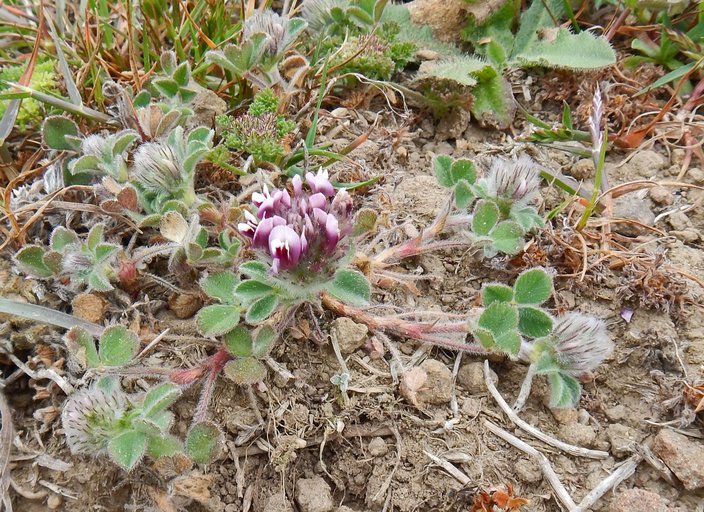
Trifolium amoenum, known by the common names showy Indian clover and two-fork clover, is endemic to California, and is an endangered annual herb that subsists in grassland areas of the San Francisco Bay Area and the northern California Coast Ranges. This wildflower has an erect growth habit and is typically found on heavy soils at elevations less than 100 meters. The flower head is somewhat spherical with a diameter of about 2. 5 centimeters. The petals are purple gradating to white tips. History and Edward Lee Greene collected the first recorded specimen of this plant in 1890 in Vacaville, California Solano County. The historical range of Trifolium amoenum was from the western extreme of the Sacramento Valley in Solano County west and north to Marin and Sonoma Counties, where many sites were presumed extirpated by urban and agricultural development. Due to the further expansion of the human population, Trifolium amoenum became a rare species by the mid-1900s. Through the latter 1900s, the number of distinct populations dwindled to about 20 in number, from pressure of an expanding human population and urban development. Rediscovery. By 1993 Trifolium amoenum was thought to be extinct, after the population in Vacaville, California depleted, but was rediscovered by Peter Connors in the form of a single plant on a site in western Sonoma County. The seeds from this single plant organism were used to grow more specimens. The Sonoma County location has been developed and any plants remaining there have been extirpated. Presently there is only a single extant population, subsequently discovered in 1996 in northern Marin County, which numbers approximately 200 plants. Trifolium amoenum became a federally listed endangered species in 1997. Recent conservation research on Trifolium amoenum has been conducted by the Bodega Marine Laboratory.
Annual herb
2 ft Tall

Green, Purple, White
Butterflies and moths supported
0 confirmed and 47 likely
Garden Webworm Moth
Achyra rantalis
Ipsilon Dart
Agrotis ipsilon
Vancouver Dart Moth
Agrotis vancouverensis
Venerable Dart
Agrotis venerabilis