

Carried by 11 nurseries
View Availability at NurseryData provided by the participants of the Consortium of California Herbaria
View additional distribution information on the Jepson eflora
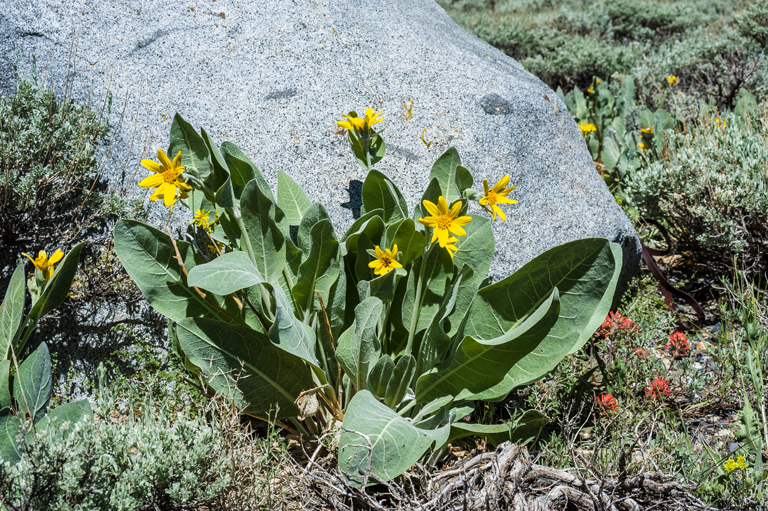
Mule Ears (Wyethia mollis) is one of several species in this genus that are found in California. It is a native perennial herb in the Asteraceae (Sunflower) family that grows primarily in the Sierra from Fresno County northward. It is slow growing and long-lived, developing an upright form, with active growth during the spring and summer. Flowers are yellow and striking, and bloom in the late spring. Leaves are white-gray and deciduous. It tends to be a pioneer species, growing in open grassy areas or recently burned sites, at elevations from 4500 to 10,600 feet. Afternoon shade is helpful. It can handle very cold, snowy winters. For southern California mountain gardens, Wyethia ovata would be a better choice.
Perennial herb
2 ft Tall
3 ft Wide
Upright
Slow
Winter Deciduous

White, Yellow
Spring, Summer
Partial Shade, Full Sun
Very Low
Max 1x / month once established
Moderate
Tolerates cold to -20° F
Fast, Medium, Slow
Tolerates a variety of soils, often rocky.
Soil PH: 5.5 - 7.2
For propagating by seed: 3 months stratification. No treatment may give satisfactory germination.
Open grassy places, clearings, disturbed places, recently burned places, at moderate to high elevations
Lodgepole Forest, Red Fir Forest, Subalpine Forest, Yellow Pine Forest
Trees: Lodgepole Pine (Pinus contorta), Red Fir (Abies magnifica), Douglas Fir (Pseudotsuga menziesii), Yellow Pine (Pinus ponderosa), Limber Pine (Pinus flexilis), White Pine (Pinus monticola), Quaking Aspen (Populus tremuloides), Western Hemlock (Tsuga mertensiana)
Shrubs: Manzanita (Arctostaphylos spp.), Ceanothus spp., Serviceberry (Amelanchier spp.), Antelope Bush (Purshia tridentata), grasses such as Agrostis spp.