

Carried by 9 nurseries
View Availability at NurseryData provided by the participants of the Consortium of California Herbaria
View additional distribution information on the Jepson eflora
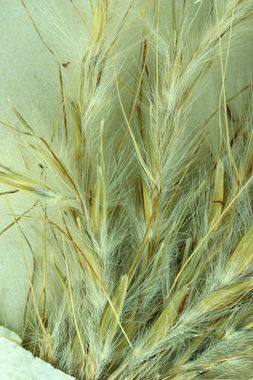
Bothriochloa barbinodis is a species of grass known by the common name cane bluestem. It is native to the Americas, including most of South and Central America, Mexico, and the southernmost continental United States from California to Florida. It is known elsewhere as an introduced species and sometimes a weed, such as in Hawaii. This is a perennial grass growing in upright clumps 60 to 120 centimeters tall. The straw-colored stems have nodes at intervals which are fringed with fluffy hairs. The leaves are 20 to 30 centimeters long and blue-green when new, drying to a reddish yellow. The flower cluster is a feathery array of spikelet units. Each unit is composed of one hairy, tan, fertile spikelet with a twisted awn up to 3.5 centimeters long twinned with a stalked, sterile spikelet which is much smaller and lacks an awn. The long-haired spikelets are wind-dispersed. In its native range, this grass is useful as a forage for grazing animals and a groundcover for revegetating cleared land. It is very drought resistant. It is considered an indicator of rangeland damage, as it is often one of the first native species to be eliminated when an area is overgrazed. It is grown as an ornamental plant for its showy flower clusters.
Grass
2 - 4 ft Tall
Upright
Fast

Yellow, White, Red
Winter, Spring, Summer, Fall
Lawn alternative
Full Sun
Low
Moderate
Fast, Medium, Slow
Tolerates a variety of soil types but best on calcareous, deep loams, or sandy loams.
For propagating by seed: No treatment. Germination may be poor.
Dry slopes
Coastal Sage Scrub, Joshua Tree Woodland
Butterflies and moths supported
0 confirmed and 1 likely
Common Wood Nymph
Cercyonis pegala