

Carried by 13 nurseries
View Availability at NurseryData provided by the participants of the Consortium of California Herbaria
View additional distribution information on the Jepson eflora
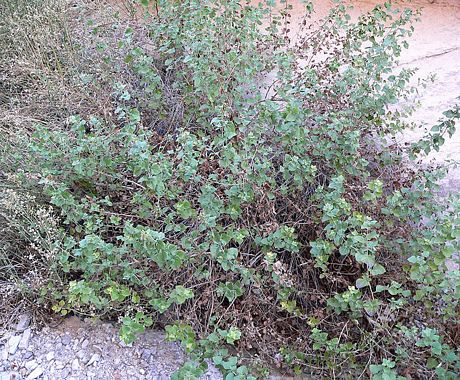
A species of flowering plant in the Asteraceae (Sunflower) family known by the common name California Brickellbush. It is native to western North America from Baja California to Idaho to Oklahoma. It is a common plant in many habitat types, especially in dry areas, somewhat more common in the southern coastal part of the state. One of the best smelling California native plants. Although not particularly beautiful, it has an amazing fragrance that comes out in the summer months when it is in bloom, and the fragrance can carry a considerable distance. This is a thickly branching shrub growing one half to two meters in height. The fuzzy, hairy leaves are roughly triangular in shape with toothed to serrated edges. The leaves are 1 to 6 centimeters long. Although it is in the Sunflower family, the inconspicuous flowers look nothing like sunflower, being very small and rayless. The flower clusters at the end of stem branches contain many small leaves and bunches of narrow, cylindrical flower heads. Each head is about 13 millimeters long and wrapped in flat, wide, purplish green overlapping phyllaries. At the tip of the head are a number of long white to pink disc florets. The fruit is a hairy cylindrical achene 3 millimeters long with a pappus of bristles. In the garden it is best used in a location where its fragrance can be appreciated but its lack of showiness will not detract (see companion plants below).
Shrub
2 - 7 ft Tall
2 - 7 ft Wide
Mounding, Spreading
Moderate
Evergreen
Pleasant

Yellow, Cream, White
Summer, Fall
Full Sun, Partial Shade
Very Low, Low, Moderate
Max 2x / month once established
Tolerates cold to -15° F
Fast, Medium, Slow
Tolerant of sandy or clay soil, often in rocky soil.
Soil PH: 5.0 - 8.0
For propagating by seed: No treatment. Germination may be poor.
1, 2, 3, 7*, 8, 9, 10, 11, 12, 13, 14*, 15*, 16*, 18*, 19*, 20*, 21*, 22*, 23*, 24*
In southern California it is found in relatively dry areas such as slopes, canyons, and foothills. In central to northern California it inhabits somewhat more mesic areas such as meadows and openings in forest or woodland
Chaparral, Coastal Sage Scrub, Foothill Woodland, Valley Grassland, Yellow Pine Forest
Use with more showy shrubs such as Manzanita (Arctostaphylos spp.), Ceanothus spp., Gooseberry (Ribes spp.), Matilija Poppy (Romneya coulteri), Flannelbush (Fremontodendron spp.), or trees such as oaks (Quercus spp.) or Pines (Pinus spp.).
Butterflies and moths supported
1 confirmed and 1 likely