

Carried by 39 nurseries
View Availability at NurseryData provided by the participants of the Consortium of California Herbaria
View additional distribution information on the Jepson eflora
California Incense Cedar (Calocedrus decurrens) is a species of conifer native to western North America, with the bulk of the range in the United States, from central western Oregon through most of California and the extreme west of Nevada, and also a short distance into northwest Mexico in northern Baja California. It grows at altitudes of 160 to 9500 feet.
It is the most widely-known cedar species and is often simply called Incense Cedar without a regional qualifier. It is a large tree, with a trunk diameter up to 10 feet, and with a broad conic crown of spreading branches.
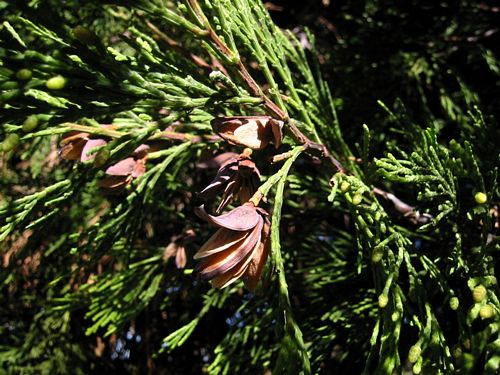
The bark is orange-brown weathering grayish, smooth at first, becoming fissured and peeling in long strips on the lower trunk on old trees. The foliage is produced in flattened sprays with short, scale-like leaves. The leaves are bright green on both sides of the shoots.
Easy to grow in the garden but requires plenty of room. If given deep, infrequent watering when young, it will develop drought tolerance.
Tree
12 - 197 ft Tall
50 ft Wide
Pyramidal
Moderate, Slow
Evergreen
Pleasant

Yellow
Spring
Bank stabilization, Hedge
Full Sun, Partial Shade
Moderate
Max 2x / month once established
Easy
Tolerates cold to -5 - -10° F
Medium
Prefers deep woodland soil with high organic content.
Tolerates serpentine soil..
Soil PH: 5.0 - 7.6
Prune in winter when wood boring insects are less active.
For propagating by seed: 2 mos. stratification; No treatment may give good germination (USDA Forest Service 1974).
1, 2*, 3, 4*, 5*, 6*, 7*, 8, 9, 11, 12, 14*, 15*, 16*, 17*, 18*, 19*, 20*, 21*, 22*, 23*, 24*
Varied, tolerates a wide variety of rainfall levels, soil types over most of California
Mixed Evergreen Forest, Yellow Pine Forest
Due to its adaptability to varying conditions and locations throughout the state, Incense Cedar has a great many companion plants.
Butterflies and moths supported
0 confirmed and 5 likely
To learn more, visit the Jepson Herbarium's YouTube channel and watch a short video about this species: https://www.youtube.com/watch?v=CIA1tkuY0B0