

Carried by 17 nurseries
View Availability at NurseryData provided by the participants of the Consortium of California Herbaria
View additional distribution information on the Jepson eflora
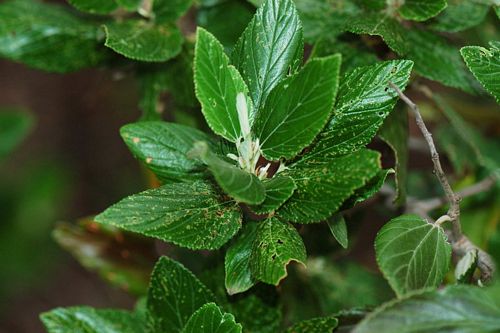
Ceanothus arboreus is a species of shrub endemic to California, especially to the Channel Islands. It is known commonly as feltleaf ceanothus. It is a species of what are sometimes called California lilacs, and may be referred to as the California mountain lilac or island mountain lilac. It is one of the tallest of the genus, growing up to 25-30 ft. in height, bearing glossy dark green leaves which are leathery or felt-like on their undersides. It is sometimes planted as a fast-growing ornamental for its showy bright blue flowers, which grow in plentiful panicles, or bunches, of tiny five-lobed blossoms. Some varieties and cultivars have light, powder blue blooms, and others bear darker blue flowers. One named variety is known as 'Owlswood Blue'. The species is used as a parent in popular ornamental hybrids such as 'Ray Hartman'. The fruits are three-lobed, triangular capsules. As a native of dry California, the plant is drought-tolerant and may be found in chaparral ecosystems. It has a reputation for being short lived, but life span is improved by not overwatering, withholding summer water and replicating natural conditions as much as possible.
Shrub
20 - 30 ft Tall
10 ft Wide
Rounded
Fast
Evergreen
Pleasant

Blue
Winter, Spring
Bank stabilization
Full Sun
Very Low
Never irrigate once established
Easy
Tolerates cold to 15° F
Fast, Medium
Tolerates a variety of soils but does best and lives longest in well drained soil.
Soil PH: 6.0 - 8.0
Prune in dry season to reduce chance of infection through the wound
Because Ceanothus species hybridize freely, propagation by cuttings is usually recommended in order to obtain a true representative of a given taxa. For propagating by seed: Hot water; then 2 mos. stratification may improve germination.
7, 8, 9, 14*, 15*, 16*, 17*, 19*, 20*, 21*, 22*, 23*, 24*
Dry slopes among chaparral, primarily on the Channel Islands. Does best near the coast (within about 20 miles) where island conditions can be replicated.
Chaparral
Ideal companions are other island plants such as Catalina Cherry (Prunus ilicifolia ssp. lyonii), Island Mallow (Malva assurgentiflora), Island Live Oak (Quercus tomentella), and Island Ironwood (Lyonothamnus floribundus ssp. aspleniifolius), but any chaparral plants will also work.
Butterflies and moths supported
1 confirmed and 19 likely
Western Avocado Leafroller Moth
Amorbia cuneana
Orange Tortrix Moth
Argyrotaenia franciscana
Alfalfa Looper Moth
Autographa californica